
PLANTS | ANIMALS | ECOLOGY | FUNGI | GEOLOGY | GARDENING | TOOLS>
Excerpts from Jim Conrad's
Naturalist Newsletter
from the April 7, 2013 Newsletter issued from the Frio Canyon Nature Education Center in northern Uvalde County, southwestern Texas, on the southern border of the Edwards Plateau; elevation ~1750m (~5750 ft); N29.62°, W99.86°; USA
SONG SPARROWS
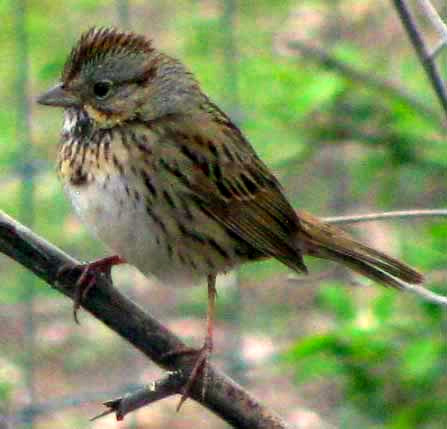
Once more below the kitchen window little brown sparrows with striped backs were hopping about pecking at sow thistle fruits, and once more the birds didn't look like the usual Chipping Sparrows. You can see one displaying a conspicuous dark spot on his chest below:
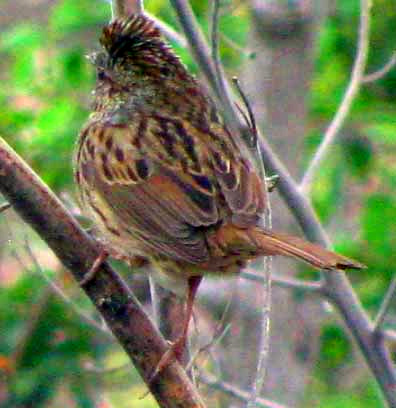
Below is a rear view of the same bird showing his striped back:
Not many sparrow species with streaked chests display such a conspicuous dark spot in the chest's center. Fox Sparrows do but they're more rusty-red overall. The spot immediately cued me that this was probably a Song Sparrow, even though it didn't quite look like the ones I know so well from Kentucky, Mississippi and the West Coast.
However, I remembered that Song Sparrows occupy many habitats over a large distribution area from coast to coast in North America, and that consequently 24 subspecies have been recognized -- or 31, 39 or some other number, depending on your expert. Song Sparrows are one of the most regionally variable birds in North America. In general, coastal and northern birds are darker and streakier, while southern and desert birds look paler. These birds outside my window stuck me as being less streaked than what I'm used to.
However, the birds below the kitchen window were indeed Song Sparrows, MELOSPIZA MELODIA, the melodia in their technical name reminding us how prettily they sing. For me their songs will always evoke happy memories from back on the farm in Kentucky many years ago.
Song Sparrows have a distinctive manner of flying. They make short flights close to the ground with a characteristic downward pumping of the tail; their rear ends sort of wobble up and down as they fly.
This is one bird species that every North American birder should be familiar with because it occurs in so many habitats, from open desert to forest edges to backyard bird feeders and suburban lawns.
I'm sorry that the ones below my kitchen window won't be staying long. Song Sparrows occur in Texas and the southern half of the US only during the winter. They nest in Canada and the northern half of the US.