
PLANTS | ANIMALS | ECOLOGY | FUNGI | GEOLOGY | GARDENING | TOOLS
Excerpts from Jim Conrad's
Naturalist Newsletter
from the September 1, 2013 Newsletter issued from the Frio Canyon Nature Education Center in the valley of the Dry Frio River in northern Uvalde County, southwestern Texas, on the southern border of the Edwards Plateau; elevation ~1750m (~5750 ft); N29.62°, W99.86°; USA
TEXAS CICHLID
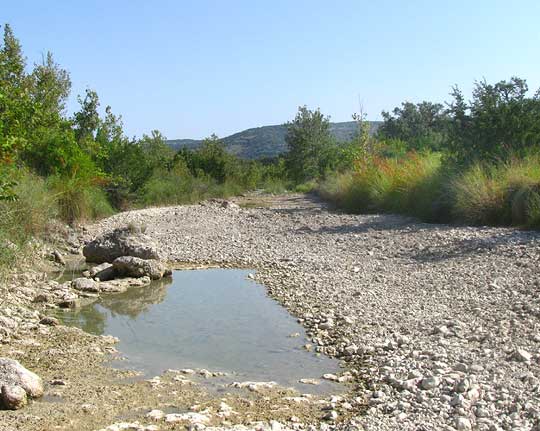
The Dry Frio River is the driest I've seen it during my year here, in most places its waters shrunk to occasional shallow pools, as shown below.
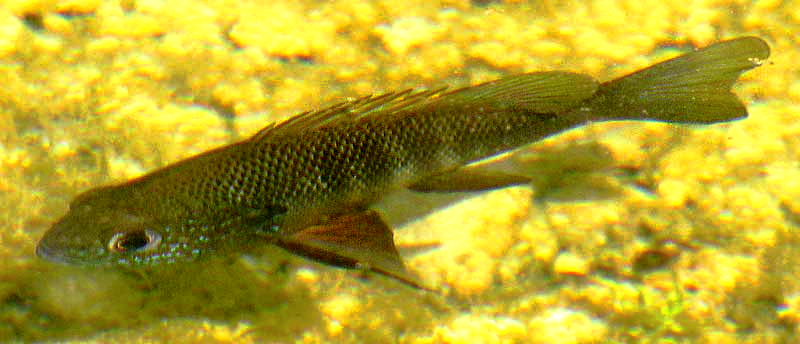
While photographing the pool's numerous Largemouth Bass I noticed a small fish (four inches, 10cm) right beside me calmly watching. With front, lower fins -- pelvic fins -- unusually large and dark, and his head speckled with light turquoise dots, he was unusually handsome, as you can see at the top of this page.
To identify this one I searched on the web for fish species known to occur in the Dry Frio River of Texas, and looked at pictures of each species. Only four or five species were listed, though surely there are more. This approach led me to the Texas Cichlid, also known as the Rio Grande Cichlid, HERICHTHYS CYANOGUTTATUS.
Texas Cichlids occur naturally in the lower Rio Grande Drainage of Texas and northeastern Mexico but they've been introduced beyond their native distribution as far north as central Texas, and in the East in Florida and Lake Pontchartrain in Louisiana. They're stocked in other areas because they're regarded as good eating.
I'm unsure whether Texas Cichlids are native to the Dry Frio River, which is not part of the Rio Grande Drainage Area; our waters drain to the Gulf of Mexico at Corpus Christi. In Robert Kuehne's 1955 publication Stream Surveys of the Guadalupe and San Antonio Rivers Texas Cichlids are reported as having spread into several tributaries. Also, Kuehne writes, "Cold water during severe winters controls the numbers in downstream areas but near the regulated waters of the river source the fish has almost crowded out sunfish and bass by sheer weight of numbers." In those rivers Texas Cichlids were regarded as invasives damaging populations of native fish. Elsewhere I read of the poison rotenone controversially being used by the Texas Fish, Game, and Oyster Commission in 1951 to rid certain streams of Texas Cichlids.
Cichlids are mainly tropical and semitropical freshwater fish of the Cichlid Family which, with over 1650 species, is one of the largest of all vertebrate families. However, the Texas Cichlid is North America's only native cichlid species.
One field mark of cichlids is that they have "protrusible mouths," which enables them to shoot their lips forward to snatch prey. It looks weird, as if the lips were on billows that suddenly shoot from the mouth.
Cichlids are much sought after as aquarium fish because of their colorfulness and diverse forms and behaviors. The popular aquarium Angelfish is a cichlid, as is the much eaten and aquacultured Tilapia. Cichlid species are best represented in Africa and South America.