PLANTS | ANIMALS | ECOLOGY | FUNGI | GEOLOGY | GARDENING | TOOLS
MEXICAN PLANTS & ANIMALS HOME

Excerpts from Jim Conrad's
Naturalist Newsletter
from the December 7, 2014 Newsletter issued from Río Lagartos, on the Yucatan Peninsula's northern coast (~N21.60°, ~W88.16°), Yucatán state, MÉXICO
SHOALGRASS
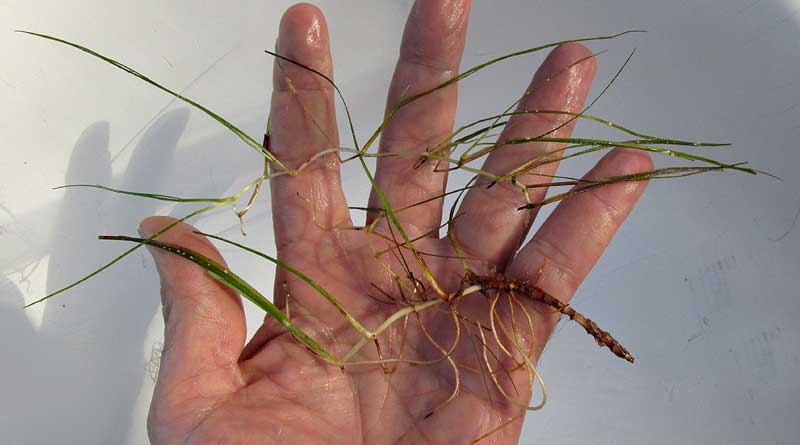
Sometimes during flamingo trips up Río Lagartos Estuary, the boat passes through patches of water where it looks like someone has dumped a lot of lawn grass pulled up with their rhizomes attached. It's easy enough to reach over the boat's edge and snatch up samples, which is what I did to get the picture shown above. In that picture the grass-like blades issue from short vertical stems at the base of which brown, shaggy scales occur where the stems attach to the white, succulent, rootlike rhizome, as seen below:
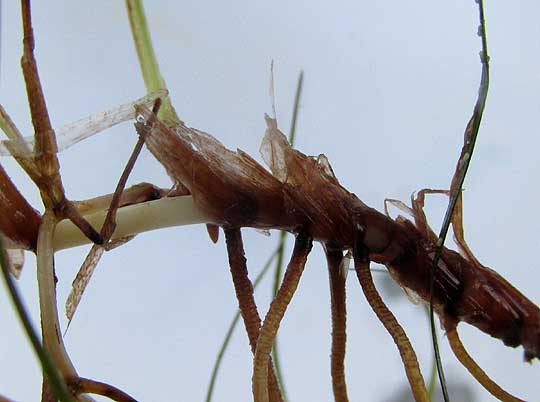
Pluck as many of these blades-attached-to-rhizomes as you want from the water and you'll not find any with flowers attached. Therefore, it took a bit of study of tropical American estuary aquatic vegetation before it occurred to me that our grasslike plants weren't grasses at all, but rather members of the small, seldom-heard-of but profoundly important Manatee-Grass Family, the Cymodoceaceae, whose members are all aquatic plants.
The only member of the Manatee-Grass Family listed on the list of plants occurring in Ría Lagartos Biosphere Reserve is Halodule beaudettei, which most botanists now call Halodule wrightii. Happily, pictures on the Internet labeled Halodule wrightii look just like ours. Another closely related and similar aquatic, grasslike species occurs in the area, but that species produces rounded leaves. Our plant's leaves are decidedly flat, like blades of grass, as you can see below:
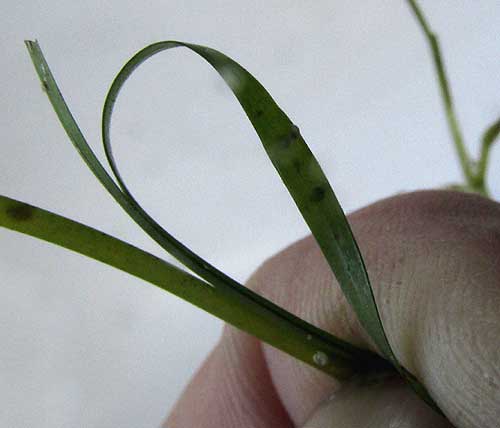
Therefore: That grass appearing uprooted and floating at the estuary's surface during flamingo-seeing tours is HALODULE WRIGHTII, usually called Shoalgrass, the term "shoal" referring to an area of shallow water.
Shoalgrass occupies the Gulf of Mexico's shallowest waters, normally less than seven feet deep (2m). In fact, the plants are often exposed during low tides. The plant occurs in intertidal zones with sandy or muddy floors from North Carolina south along Mexico's Gulf Coast and the Caribbean islands to northern South America. Also, there's a disjunct population in the eastern tropical Pacific and the Indian Ocean, and it's a dominant seagrass species in Brazil and West Africa.
Manatees used to occur in Ría Lagartos Estuary where so much of the aquatic biomass belongs to the Manatee-Grass Family, but they've been exterminated.
Ecologically, among the various seagrasses, Shoalgrass is thought of as functioning as a pioneer species that revegetates lagoon floors that have been disrupted or cleared of vegetation, plus it is more tolerant of low salinity than other seagrasses. Salinity varies a great deal throughout the Ría Lagartos Estuary.