PLANTS | ANIMALS | ECOLOGY | FUNGI | GEOLOGY | GARDENING | TOOLS
MEXICAN PLANTS & ANIMALS HOME

Excerpts from Jim Conrad's
Naturalist Newsletter
from the November 17, 2008 Newsletter issued from Yokdzonot, western Yucatán, México
POISONWOOD
One tree around here anyone who works in the woods learns early is the Poisonwood, METOPIUM BROWNEI, in Maya known as Che Che'en. Its alternate, pinnately compound, wavy-margined leaves are shown below:
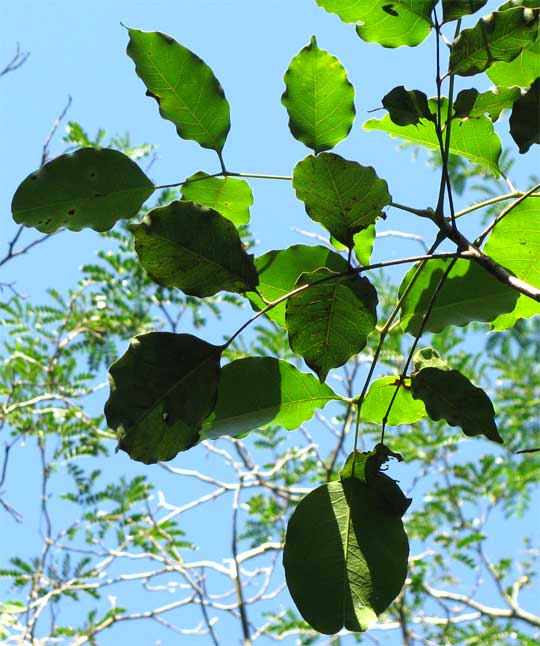
Being acquainted with this tree is important because if you get the tree's sap on your skin your skin may itch, develop a rash, and even break out in running, scar-leaving blisters. Poisonwood belongs to the Poison-Ivy or Cashew Family, the Anacardiaceae, so that explains a lot.
Besides its compound leaves, which are similar to those of ash trees up north, a good field mark to help in identification is that often the tree's trunk bears black, tar-like blotches, where sap has dried, shown below:
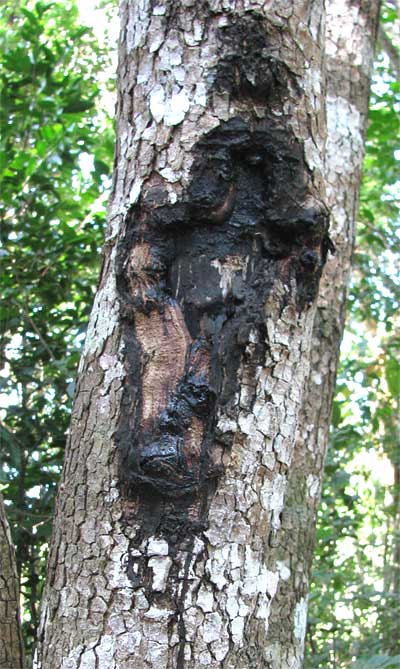
When Poisonwood sap first begins emerging from a wound on the tree it's clear. In about ten minutes it turns to a bright, rusty-red hue, then after 20 minutes it's black, and it stays black.
My impression is that Poisonwood sap causes much more than a mere allergic reaction. Most of my life I've experienced no symptoms at all when exposed to Poison Ivy, even its sap smeared on my skin (I seem to be losing some of that immunity now, however.) Still, my skin reacts to Poisonwood sap as if it were a very strong acid, producing running blisters.
from the December 8th, 2008 Newsletter issued from Yokdzonot, western Yucatán, México
WHAT POISONWOOD JUICE DID TO MY SKIN
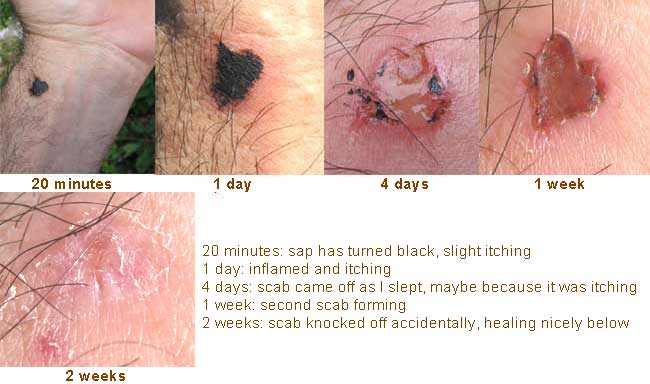
When I took the picture for the above essay I conducted a little experiment. I broke off a Poisonwood leaf and daubed a single droplet of juice onto the inside of my left wrist. The instant before I applied the juice I paused a moment, however, because exactly where I was about to daub the droplet there appeared a small, circular, white scar. This scar remained from when I conducted the same experiment with Poisonwood sap about 15 years ago when I was serving as a naturalist at a lodge in Belize. This time I put the droplet a little to the side of where I did earlier, so now I'll have two white spots.
You can see documentation of what happened to my wrist below:
In most of the area where Poisonwood grows there's typically another tree growing nearby known in Maya as Chakah, in English as Gumbo-Limbo, and to tourists as "Naked Indian Tree." It's Bursera simaruba. The sap of this tree serves as an antidote to Poisonwood juice. You can read more about Gumbo-Limbo and see its trunk at www.backyardnature.net/q/bursera.htm.
Curiously, in Yokdzonot most people didn't regard Chakah/ Gumbo-Limbo as an antidote to Poisonwood sap. They used juice from bitter-oranges, which works perfectly, they said. This causes me to believe that Poisonwood's sap is caustic with a high pH, and that anything acidic, with a low pH, might neutralize the sap. However, belonging to the Poison Ivy Family, maybe Poisonwood also causes an allergic reaction, so I'd be careful experimenting with it. I'm not allergic to Poison Ivy so I couldn't test that aspect.
from the May 15, 2011 Newsletter issued from Mayan Beach Garden Inn 20 kms north of Mahahual; Caribbean coastal beach and mangroves, ~N18.89°, ~W87.64°, Quintana Roo state, MÉXICO
POISONWOOD FLOWERING
The juice from the living cambium layer is what hurts you, not the wood. The Exotic Hardwood website says the wood 's color ranges from amber to dark brown, often with a range of colors and contrasting streaks. Also, that "This wood is quite hard, dense, and tight- grained. With care, a beautiful, lustrous finish can be obtained. Slightly oily, but not as much as teak. ...Very rot resistant."
Along the road up our little sand ridge beside the mangrove swamp, Poisonwood is one of the most common trees, and it's very conspicuous now because it's abundantly flowering and fruiting, as shown below:
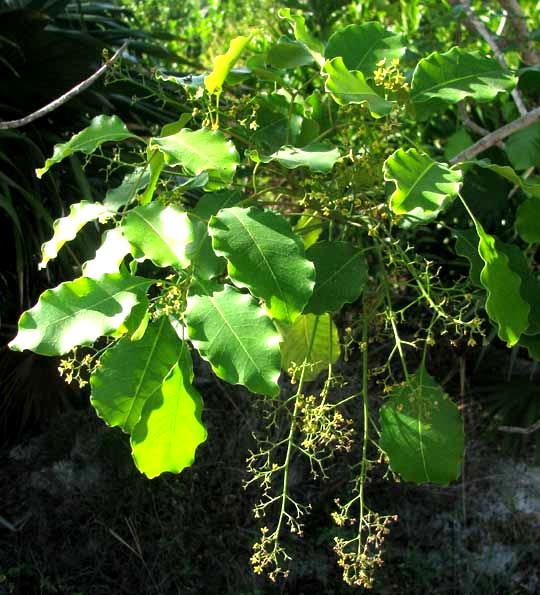
I've seen Poisonwood flowering before but never so prolifically. It's the same way with them it was with the big Ceibas back at the Hacienda which this year flowered and fruited much more abundantly than in years past. Who knows what's going on?
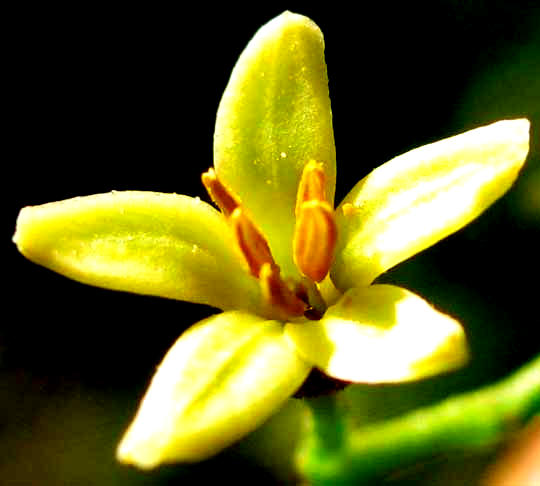
A close-up of a male Poisonwood flower with its five stamens exserted, or sticking out, is shown below:
A female flower lacking stamens but whose corolla base is filled with an oval ovary topped by three stigmas -- note the enlarging ovary in the background -- is shown below:
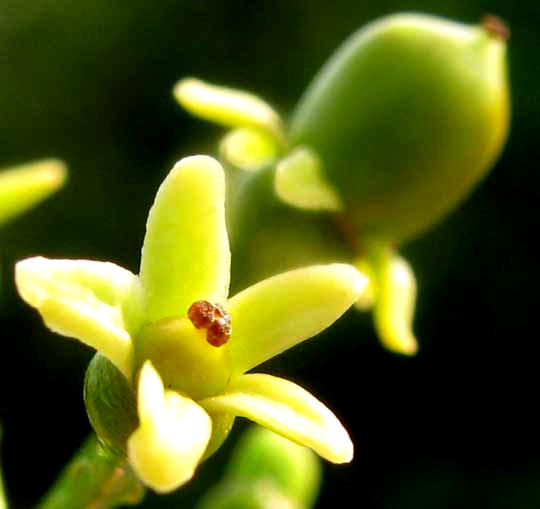
If you've taken a close look at a Poison Ivy or Sumac flower, you might have seen similarities with this one -- the small size, the pale yellowness, the stamens extending from a simple, starlike corolla -- and there's a good reason for it. Poisonwood belongs to the same family, the Cashew Family, or Anacardiaceae.
I've heard that the Maya use Poisonwood juice to burn off warts. Having seen how the juice burned through my own skin, I'd say that it probably can do that, just as a drop of any strong acid would -- basically melting the skin away.
from the September 18, 2011 Newsletter issued from Mayan Beach Garden Inn 20 kms north of Mahahual; Caribbean coastal beach and mangroves, ~N18.89°, ~W87.64°, Quintana Roo state, MÉXICO
POISONWOOD FRUITING
Now take a look at the pretty panicles of red fruit glowing warmly in hot, late-afternoon sunlight below:
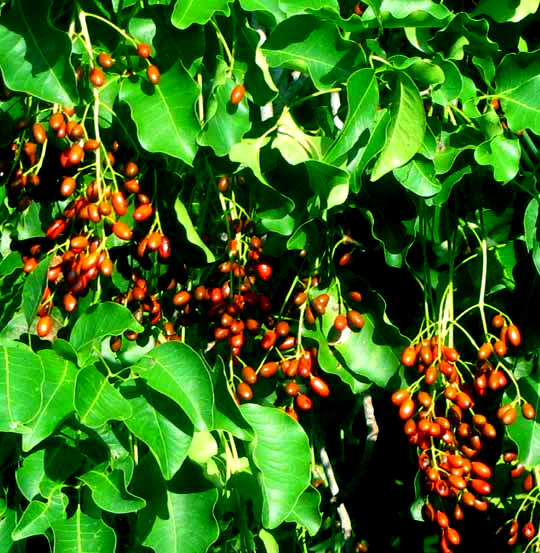
This week's migrating Eastern Kingbird gravitated into Poisonwood trees and I suspect they were feeding on these fruits. I read that the bird's winter food is heavy in fruits, such as those of Magnolia in Louisiana, which are red and fleshy like Poisonwood fruits.