PLANTS | ANIMALS | ECOLOGY | FUNGI | GEOLOGY | GARDENING | TOOLS
MEXICAN PLANTS & ANIMALS HOME

Excerpts from Jim Conrad's
Naturalist Newsletter
from the November 10, 2008 Newsletter written in Yokdzonot about half an hour by bus west of Pisté, Yucatán, México
elevation ~25m (~82 ft), N20.707°, W88.731°
PAPAYA FRUITS & FLOWERS
The neighbor across the road makes a halfhearted attempt to keep a garden space halfway cleared, and you'd be surprised what crops of oranges, tangerines, bananas, and papayas he harvests. One of his 15-ft-tall papaya trees bearing two immature papayas appears below:
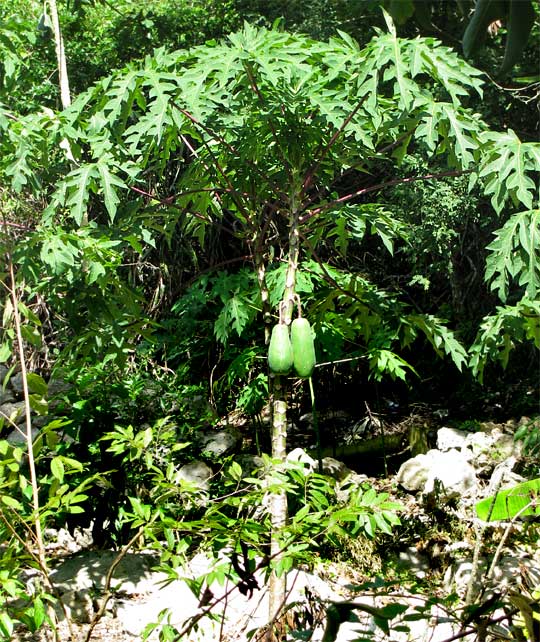
Papaya trees, CARICA PAPAYA, are native to tropical America so maybe that explains why along roadsides and in abandoned cornfields you see wild papayas. The wild papayas' fruits aren't anywhere as large as those in the picture, though, and though birds such as orioles and woodpeckers love them, humans seldom bother to pick them. Those are wild papaya trees below:
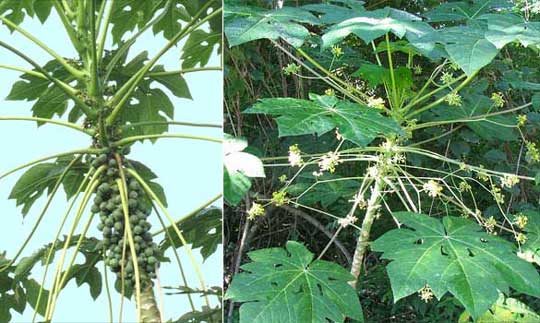
On the left in that composite picture you see a typical female wild papaya tree loaded with immature, eyeball-size fruits, while on the right you see a male tree's very different, diffuse inflorescence of male flowers.
The flower situation in the Papaya Family, the Caricaceae, is much more complex than the plants merely coming in boy and girl trees. I don't have it all figured out myself, but at least I can show you unisexual female and unisexual male flowers taken from two wild papaya trees along the road to Mexil, below:
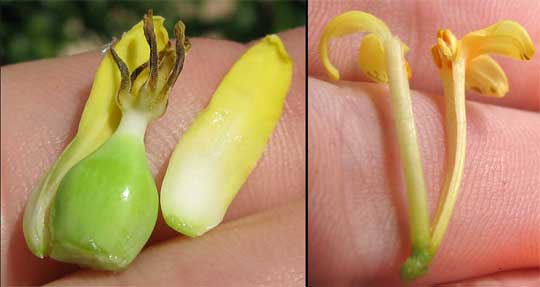
In that composite picture the broken-open blossom on the left is the female. The oval, green item is the ovary, the ovary's white "neck" is the style, and the five fingerlike brown things are the stigmas. Stigmas, style and ovary together constitute the female pistil. Pollen grains will germinate on the stigmas and send rootlike pollen tubes down through the style to ovules inside the ovary, where the male and female sex germs will unite. The ovules will mature into seeds and the ovary into a papaya fruit. The flattish, yellow items are separate petals.
On the right the male flower contains nothing like a pistil, plus its petals are united at their bases to form a slender tube. At the tube's throat you can make out baglike, yellow anthers splitting open to release pollen. Usually anthers are borne on slender filaments but these anthers are practically stemless, or "sessile." An anther and filament together constitute a male stamen.
from the January 16, 2005 Newsletter Issued from Hacienda Komchen de Los Pájaros just outside Dzemul, Yucatán, MÉXICO
PAPAYAS FROM A TREE
One of the pleasures of being here is that every now and then we notice that one of our many Papaya trees has a football-size fruit dangling beneath its umbrella-shaped canopy, turning yellow. If we let the fruit hang there too long, birds will eat it, especially the orioles. Therefore, usually we cut it off a couple of days before it reaches its peak of perfection, set it someplace where we can watch it, and then when its really ripe, what a pleasure to slice into it and just eat. Of course that's a papaya fruit above.
In my opinion, a papaya isn't perfectly ripe until its husk begins looking almost disagreeable -- the yellow surface browning here and there, even with some spots of white fungus breaking out. Well, you cut off that part and eat the perfect stuff inside. I say " in my opinion" because I'm always astonished at how many people think that a banana with brown spots is beyond eating. "In my opinion," bananas are at their best as brown spots begin appearing, and purely yellow bananas are unripe and bitter tasting! But the advertising industry has put it into people's heads that bananas need to be yellow, so what can you do? Possibly the same form of lunacy extends into papaya eating, but I don't know.
Papayas please with much more than their mere taste, texture and appearance. Something in them sets the stomach at ease, and makes your guts smile on a hot, sunny afternoon like we're having now.
That shouldn't surprise us, for traditional cooks have known for millennia to wrap their pigs in papaya leaves before baking them, and even our own culture has realized that papayas contain "the natural meat tenderizer" called papain. Papain helps our stomachs digest things.
Here Papaya trees grow all over the place, both the horticultural kind with big, football-shaped fruits, and others whose fruits are spherical and grow no larger than lemons before yellowing; those we just let the orioles have. Well, the orioles take them whether we want them to or not.
Because I like papayas so much I suggested to Ana María that we plant large numbers of them. Her reply was that planted papayas nearly never come up. The ones we have just grew on their own accord. The thing to do is to eat your papaya, scatter the seeds, and let nature take its course.
My Maya-speaking friend Don Elías tells me that if you put a papaya's seeds in water, the seeds that will produce trees bearing small, round fruits will float to the top, while the seeds producing trees bearing big fruits will sink. That doesn't make any sense at all, but usually Don Elías knows what he's talking about, so I'm remembering the advice.
What a pleasure walking down our lane at dusk, eating papaya and conscientiously spitting my seeds just everywhere!
from the January 24, 2016 Newsletter issued from Hacienda Chichen Resort beside Chichén Itzá Ruins, central Yucatán MÉXICO
PAPAYA FLOWERS
One day someone gave Don Paulino a big papaya. He's one of our gardeners so he saved the seeds, planted them in the organic garden, and now we have a nice crop of papayas, as you can see below:
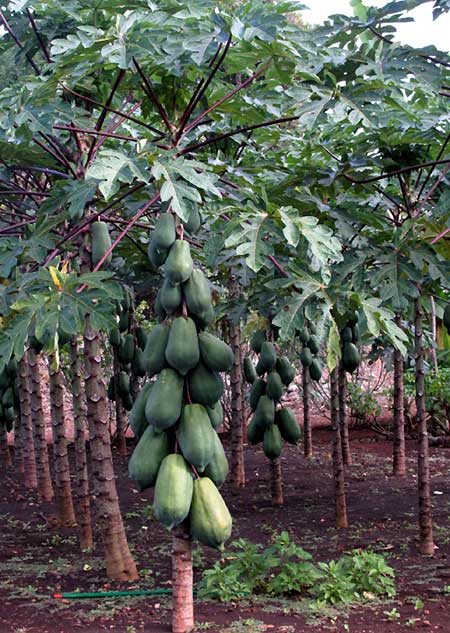
Something interesting about that shot is that some trees are heavily laden with fruit, others bear no fruits at all, and some have one or a few fruits. That's because Papaya flowers occur in one of three sexual forms: male, female, or hermaphrodite. Hermaphrodite flowers bear both male and female parts, and can pollinate themselves, not requiring another papaya plant to grow nearby.
Among Paulino's papayas I find female and hermaphroditic flowers but no strictly male ones. I read that some cultivars don't produce them, so maybe that's why. Male flowers are most easily recognized by the fact that they are produced in large numbers in diffuse, branched flowering head. {see previous entries above}
Female flowers are much larger than hermaphroditic ones, and the thick, branched, yellow-green stigma atop the ovary is easy to see, as shown below:
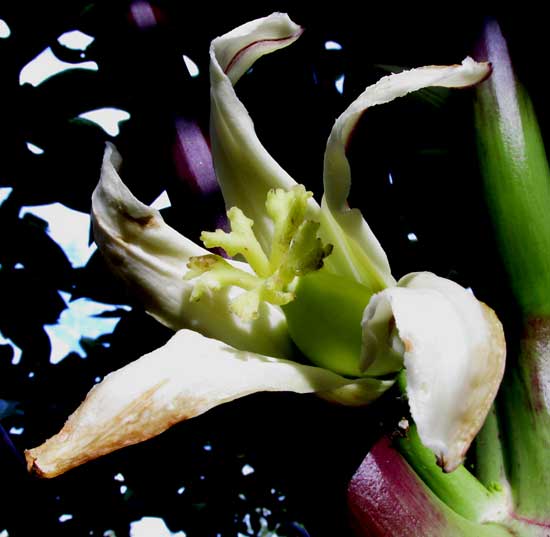
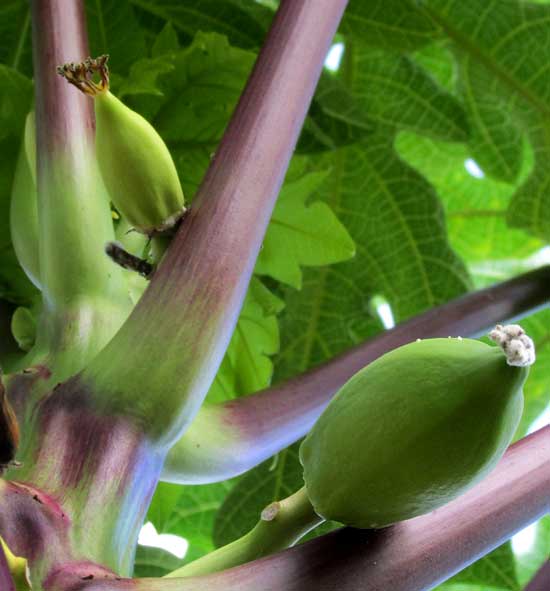
That flower has just been pollinated, so its petals are turning brown and about to fall off, leaving only the ovary to mature into a papaya fruit. Female flowers at the peak of their receptivity show only the white, urn-shaped corolla with the forked stigma at its mouth. Below, you can see maturing ovaries at different stages of maturity:
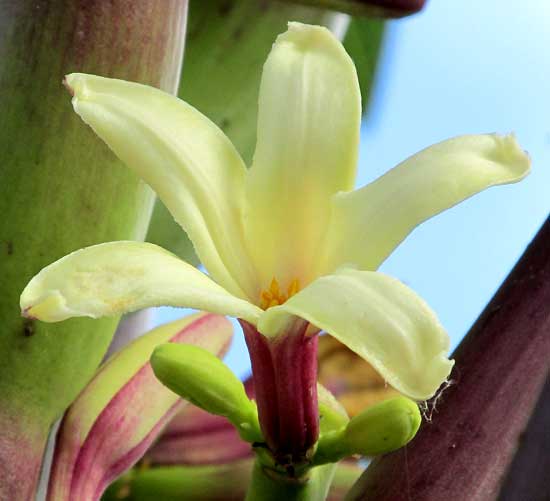
Hermaphroditic flowers are much more numerous and smaller. You see stamens clustered at their throats, while the ovaries and stigmas are hidden within the corola tube, as shown below:
I read that when growing papayas for the market, at least with some cultivars, hermaphrodite plants are preferred for dependable fruit production. However, the sexuality of such flowers can be unstable and subject to sex reversal. Cool weather or high soil moisture can lead to a shift toward femaleness, and fruits of such sex-reversed flowers develop deformations and are unmarketable.
Paulino did something interesting to some of his Papaya trees, shown below:
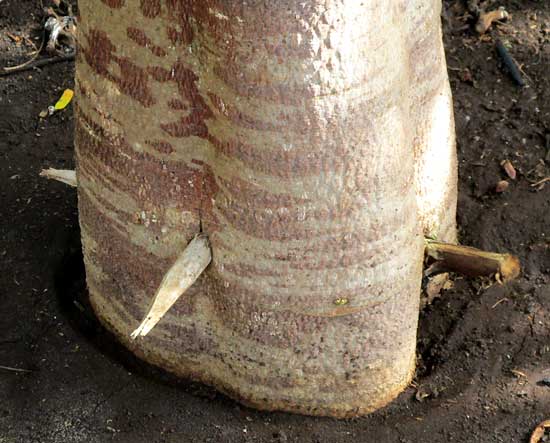
When I asked why stakes had been driven through the trunks he seemed a little embarrassed, and replied that the Maya believe that such treatment causes trees to produce more fruit.
from the March 6, 2016 Newsletter issued from Hacienda Chichen Resort beside Chichén Itzá Ruins, central Yucatán MÉXICO
HARVESTING A PAPAYA
Several months ago someone gave Don Paulino a papaya. Paulino saved the seeds, planted them, and today tends to a handsome little orchard of them in the Hacienda's organic garden area. The first papayas are beginning to ripen now, and this week one of the first was harvested, as documented below:
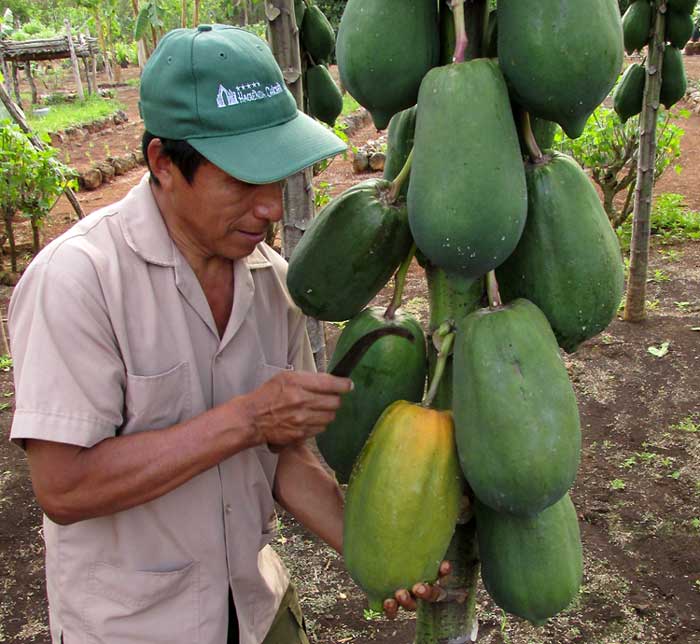
The papaya being cut from the tree isn't mature enough to eat yet, but if it's left on the tree any longer birds will start pecking it. Papayas just beginning to turn like this are taken to a storage room where they're left to mature in peace, until they become a rich, orangish-yellow with soft flesh like that of a ripe melon.
I posted the above picture on the Newsletter's FaceBook page and someone asked whether green papayas were to be eaten. I didn't know, so I asked the Maya staff.
You should have witnessed the debate that ensued, all in Maya, with only brief summaries of the issue issued in Spanish for my benefit. In the end, it seems to be the general consensus that, yes, green papaya can be eaten, but you have to prepare as you would candied sweet potato. The main disagreement seems to be whether you start by making a boiling syrup by mixing water and sugar in a pot over a fire, then add small chunks of green papaya, or whether you cook/saute/boil the papaya fragments first, then stir in syrup until it's all a gummy sort of hot jam.
from the July 27, 2007 Newsletter from Sierra Gorda Biosphere Reserve Headquarters in Jalpan, Querétaro, MÉXICO THE PAPAYA BERRY
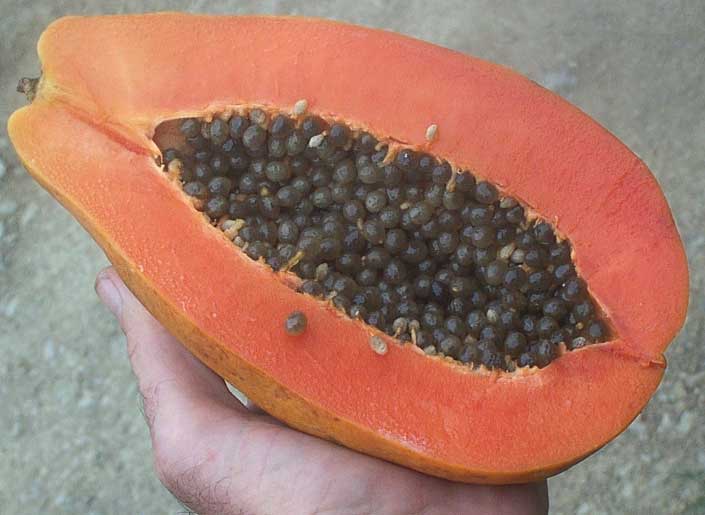
A lot of people are surprised that papayas are hollow inside, and that many soft, blackish seeds are attached to the cavity's walls by short, slender, stringlike umbilici. The attachment is so weak that a quick brush with a finger dislodges them. The seeds themselves are so soft that they can be chewed, but they have such a strong peppery taste, like wild cress, that few people bother with them.
Terminology relevant to papaya fruits can be a bit disorienting. For example, botanically, papayas are berries. Technically, a berry is a pulpy fruit developing from a single pistil, containing one or more seeds but no true stone.
Therefore, the term "berry" is much more inclusive than we usually think. Tomatoes are berries, as are oranges, grapes and cucumbers. The concept of "berry" is so general that subcategories have been defined. Cucumbers, like watermelons -- developed from inferior ovaries so that the resulting fruit is surrounded by a fleshy layer such as the watermelon's rind -- are berries of the "pepo" subcategory. Oranges are specialized berries known as hesperidia. A hesperidium possesses a thickened, leathery rind and juicy pulp divided into segments, the segments corresponding to carpels, or sections, in the original flower's ovary.
If flower terms like "carpel" and " inferior ovary" throw you for a loop you may want to review my flower page at www.backyardnature.net/fl_stand.htm.
An overview of fruit types is provided at www.backyardnature.net/fruits.htm.
from the September 6, 2018 Newsletter issued from Rancho Regenesis in the woods ±4kms west of Ek Balam Ruins; elevation ~40m (~130 ft), N~20.876°, W~88.170°, central Yucatán, MÉXICO
SEEDS GERMINATING INSIDE A PAPAYA FRUIT
The other day I cut open one of our homegrown papayas and found many of its seeds germinating, some even with green cotyledons (the future leaves), as shown below:
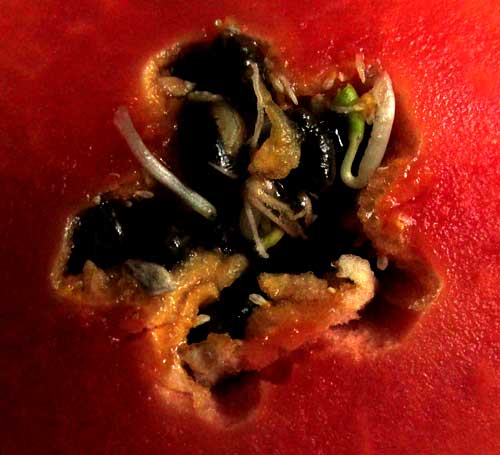
This occurs in many ripe fruits with high moisture content, such as apple, pear, peach, lemons and tomatoes. In over-ripe fruits, diminished levels of abscisic acid also encourage the breaking of seed dormancy. Notice that the fruits mentioned as sometimes producing germinating seeds are cultivars. You might say that undomesticated natural species "have more sense" than to do that.