PLANTS | ANIMALS | ECOLOGY | FUNGI | GEOLOGY | GARDENING | TOOLS
MEXICAN PLANTS & ANIMALS HOME

Excerpts from Jim Conrad's
Naturalist Newsletter
from the November 3, 2008 Newsletter written in Yokdzonot about half an hour by bus west of Pisté, Yucatán, México
elevation ~25m (~82 ft), N20.707°, W88.731°
A BLUE-FLOWERED MORNING-GLORY
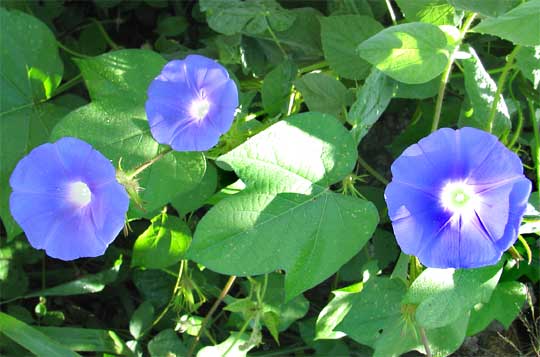
Each morning I pass by an abandoned cornfield beside which blue-flowered morning-glories flower, as shown above. Especially when sunshine lights the two-inch-broad blossoms from behind so that they glow like blue fire etched in crystal against their dark emerald, three- lobed leaves and satiny shadows, I always have to stop just to stare. Of course photographs can't capture such transcendent scintillation, just hint at it.
The plant is IPOMOEA NIL. In North America we have a closely related species, Ipomoea hederacea, the Ivyleaf Morning-glory, but that native-American species produces smaller flowers and leaves, and its leaves are much more deeply lobed. Ipomoea nil is a native of the Old World tropics, "nil" being an Arabic name for the plant. Many horticultural forms have been developed from this species, including some with fringed, frilled, fluted and double flowers, and with colors ranging from violet to rose and blue. The Imperial Japanese Morning-glories derive from Ipomoea nil.
At this time of year the Yucatán's morning-glory display is wonderful. Abandoned cornfields, forests devastated by firewood-gathering, hurricane-ravaged zones, all can become green oceans of morning-glory vines. When the vines are dewy and touched with the day's first light you see how apt the name "morning- glory" is. Comes the heat of mid afternoon, however, the flowers collapse upon themselves, the leaves wilt, and it all looks more like a Kudzu-choked field in Mississippi than any glory.