PLANTS | ANIMALS | ECOLOGY | FUNGI | GEOLOGY | GARDENING | TOOLS
MEXICAN PLANTS & ANIMALS HOME

Excerpts from Jim Conrad's
Naturalist Newsletter
from the October 27, 2008 Newsletter issued from Yokdzenot, central Yucatán, MÉXICO
WHITE-WINGED DOVES CAVORTING
Right outside my window a Mora tree's drooping branch provides a horizontal perch especially appreciated by a certain White-winged Dove who comes most mornings to ask mournfully and slightly hoarsely, who-cooks-for- YOUUUUUU, who-cooks-for-YOUUUUUU? Down at the cenote a pair seems to be considering a nest on a bromeliad-and lichen-adorned branch, as you can see below:
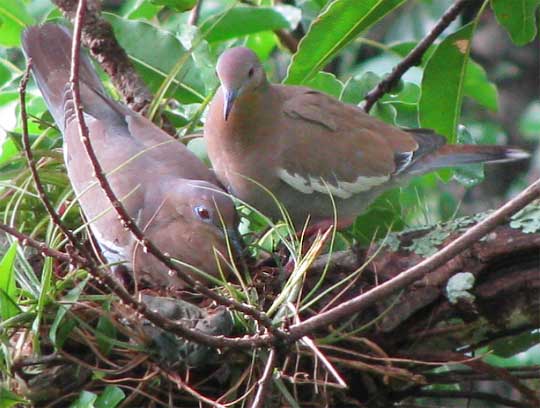
That picture shows that the species' white wingbar is impossible to miss, making it easy to distinguish between White-wingeds and our other common dove, the White-tipped Dove, whose picture you can compare at www.backyardnature.net/yucatan/dove-wt.htm.
The White-winged picture also gives us a glimpse into just how social and attentive to one another these birds are, the male hardly able to refrain from brushing his chest against his mate as she snuggles into her potential nest, testing, feeling, maybe imagining herself sitting there during rain and wind incubating her brood.
In A Guide to The Birds of Mexico and Northern Central America, Howell describes the White-winged Dove's plumage as displaying a "... bold white bar across upperwing from outer lesser through greater coverts; remiges blackish. Central rectrices brown, outer rectrices grey, broadly tipped white." I had to review some terms before I understood what he was saying.
from the November 15, 2005 Newsletter issued from near Telchac Pueblo in northwestern Yucatán, MÉXICO
WHITE-WINGED DOVES
Stone walls of white limestone rock and up to ten feet high surround and crisscross the hacienda. In early mornings I like to sit atop the taller ones watching birds. Not only does the extra elevation afford a better view but it also puts me above most mosquitoes.
A typical occurence while I'm perched there is for a flock of ten or so White-winged Doves to come flying low over the scrub and when they come to the wall they usually clear by just inches they are surprized to find me sitting there. During the split second before our encounter I hear their fast-approaching wing- whoosh, then as they put on their brakes and veer hard to miss me it's amazing how loud the feather-against-feather sound is, like the hard beating of a close-by kite in strong wind.
To produce such speed and powerful flapping sounds it's clear that these birds' flying muscles are well developed. In fact, it's those big pectorals that attract the attention of hunters, for the doves' "meaty breasts" are thought by some to be good eating.
At first glance White-winged Doves look and behave similarly to North America's Mourning Doves, except that there's a lot of white in the White-winged's wings forming conspicuous white bars along the wings' lower edge when the birds are perching. Also, Mourning Doves have long, pointed tails while White- wings have blunt, pigeon-like tails. The two species are enough alike, however, to be placed in the same genus, ZENAIDA.
Mourning Doves overwinter in the Yucatan but I've not seen them, while White-winged Doves well may be the most commonly occurring and conspicous of all bird species in our scrub. They are distributed throughout nearly all of Mexico, into the US Southwest.
from the February 27, 2011 Newsletter issued from Hacienda Chichen Resort beside Chichén Itzá Ruins, central Yucatán, MÉXICO; limestone bedrock, elevation ~39m (~128ft), ~N20.676°, ~W88.569°
RESOLUTE WHITE-WINGED DOVES
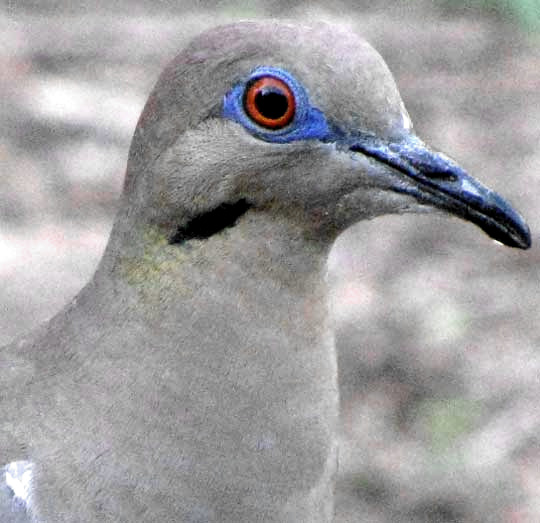
For the last few days at dusk as I've sat reading before the hut, a White-winged Dove has arrived during the last moments of light to drink at my birdbath. This is a bit daring, for I'm sitting only six feet away (2m). A portrait just of that bird's face with its characteristic amber eyes surrounded by indigo-blue skin, black stripe below the ear feathers (the auriculars), and a subtle flush of golden just below the stripe, all on a pale gray-brown background, is below:
Some bird species are persnickety, maybe eating just a narrow range of foods, or foraging at a certain level in trees. White-winged Doves are more generalist and opportunistic. You see them foraging on the ground, eating fruits in trees and even hanging out in Pisté's garbage dump. A picture showing one tugging a seed from a leathery, splitting Frangipani fruit is shown below.
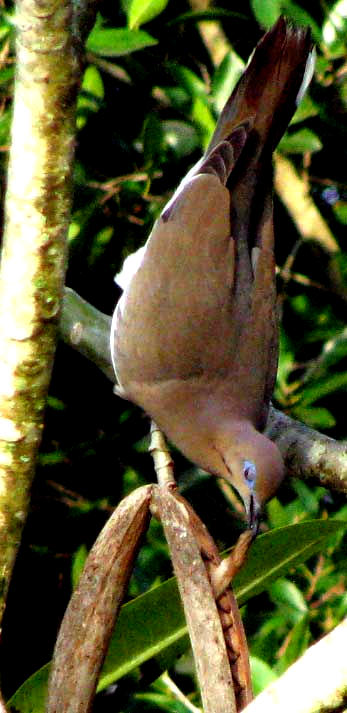
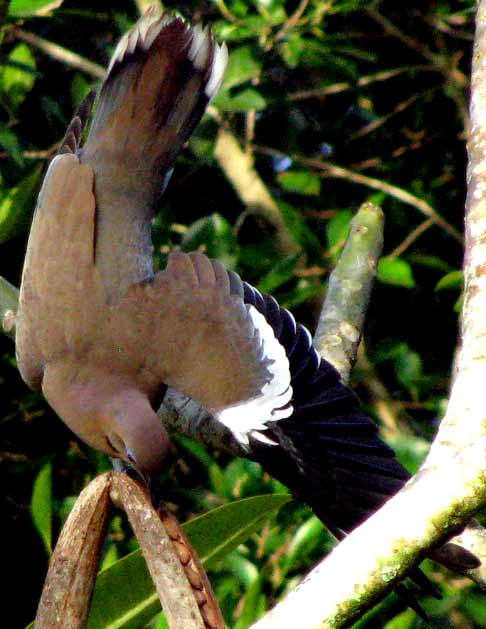
Something interesting about that picture is that getting the seed out was tricky for the bird. Before the successful extraction documented in the picture, several times the bird had lost his balance and tipped from his perch. You can see the very moment of such a crash, a wing vainly groping for support where there is none at the bottom of this page
Besides being generalist and opportunistic, my impression is that White-winged Doves are especially resolute about what they set out to do.