PLANTS | ANIMALS | ECOLOGY | FUNGI | GEOLOGY | GARDENING | TOOLS
MEXICAN PLANTS & ANIMALS HOME

Excerpts from Jim Conrad's
Naturalist Newsletter
from the July 6, 2007 Newsletter issued from Sierra Gorda Biosphere Reserve, QUERÉTARO, MÉXICO
SCORPION
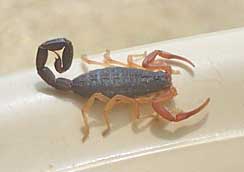 The other day Silvestre came to my casita window carrying a scorpion in a bottle. He'd found the scorpion while cutting grass with a hedge-trimmer. You can see the scorpion 0n my plastic oatmeal-bowl at the right.
It was a small scorpion measuring only 3/4 inch (2 cm) from the front of the head to the backmost part of the curled up tail. Speaking of the curled tail, note the sharp, curved stinger inside the coil, arising from the last tail segment.
Probably this is a juvenile CENTRUROIDES GRACILIS. Adults of this species are larger and all black. It's a native Mexican and Central American species but has been introduced into Africa and elsewhere, including the southern US, where sometimes it's known as the Slender Brown Scorpion or the Florida Bark Scorpion.
In many countries I've run into the common wisdom that small scorpion species tend to be much more venomous than larger ones. Centruroides gracilis agrees with that idea, for it's known as inflicting a sting much worse than those of our bigger species.
There's a forum page with posts from people who have been stung by this species at http://www.arachnoboards.com/ab/archive/index.php/t-445.html.
A page in PDF format on the species' life cycle can be accessed here.
from the August 10, 2007 Newsletter issued from Sierra Gorda Biosphere Reserve, QUERÉTARO, MÉXICO
SCORPION EXUVIA
Scorpions, like spiders, have "outside skeletons," or exoskeletons, so as they grow they must molt one husk after the other, the molting process being known as "ecdysis." The molted exoskeleton is called an "exuvia"
(plural exuviae). So, the other day, atop the switch that opens the gate, which several of us grope for each night to let in or out those without keys, I found the neat little scorpion exuvia shown below:
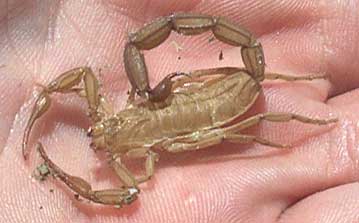
Probably this is the exuvia of the same species I profiled in the July 6th Newsletter, CENTRUROIDES GRACILIS, known as the Slender Brown Scorpion or Florida Bark Scorpion, and whose portrait resides at the top of this page.
An interesting feature of that exuvia is that it bears what appears to be an intact stinger, or "telson." The handlens shows a perfectly preserved stinger, but I assume that it's empty of the glands producing venom. Scorpions typically require between five and seven molts to reach maturity.
While confirming the above fancy scorpion terms I learned that most scorpions are slightly fluorescent, something discovered by geologists in Arizona in the 1940s. In the 1970s only about 600 scorpion species were known to science but now over 1520 have been named, thanks mostly to researchers knowing to look for new species at night using "UV flashlights."