PLANTS | ANIMALS | ECOLOGY | FUNGI | GEOLOGY | GARDENING | TOOLS
MEXICAN PLANTS & ANIMALS HOME

Excerpts from Jim Conrad's
Naturalist Newsletter
from the July 27, 2007 Newsletter issued from Sierra Gorda Biosphere Reserve, QUERÉTARO, MÉXICO
THE PAPAYA BERRY
This week I bought a small papaya. While I had it split open I took a picture of it, which you can see below:
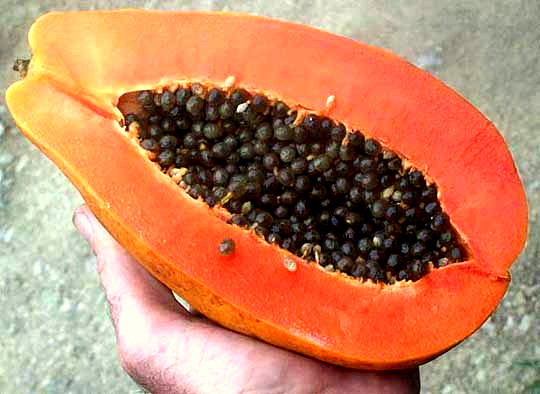
A lot of people are surprised that papayas are hollow inside, and that many soft, blackish seeds are attached to the cavity's walls by short, slender, stringlike umbilici. The attachment is so weak that a quick brush with a finger dislodges them. The seeds themselves are so soft that they can be chewed, but they have such a strong peppery taste, like wild cress, that few people bother with them.
Terminology relevant to papaya fruits can be a bit disorienting. For example, botanically, papayas are berries. Technically, a berry is a pulpy fruit developing from a single pistil, containing one or more seeds but no true stone.
Therefore, the term "berry" is much more inclusive than we usually think. Tomatoes are berries, as are oranges, grapes and cucumbers. The concept of "berry" is so general that subcategories have beene defined. Cucumbers, like watermelons -- developed from inferior ovaries so that the resulting fruit is surrounded by a fleshy layer such as the watermelon's rind -- are berries of the "pepo" subcategory. Oranges are specialized berries known as hesperidia. A hesperidium possesses a thickened, leathery rind and juicy pulp divided into segments, the segments corresponding to carpels, or sections, in the original flower's ovary.
If flower terms like "carpel" and " inferior ovary" throw you for a loop you may want to review my flower page at www.backyardnature.net/fl_stand.htm.
An overview of fruit types is provided at www.backyardnature.net/fruits.htm.