PLANTS | ANIMALS | ECOLOGY | FUNGI | GEOLOGY | GARDENING | TOOLS
MEXICAN PLANTS & ANIMALS HOME

Excerpts from Jim Conrad's
Naturalist Newsletter
from the January 5, 2007 Newsletter issued from Sierra Gorda Biosphere Reserve, QUERÉTARO, MÉXICO
ZEBRA LONGWING BUTTERFLIES ON A COLD MORNING
Over the long New Year weekend I camped in the mountains just outside Jalpan. Yet another norther was moving through so the first hours of 2007 found me in a cold, wet tent. I'd prepared for it, however, and at dawn on New Year's Day it was cozy lying in my sleeping bag gazing into the misty valley below. Green Jays orbited around the tent giving me the eye, squawking and flashing their yellow undertails.
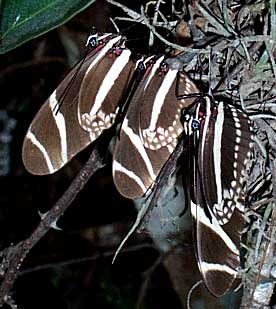 The drizzle ended and I went snooping. Often on such chilly days you can find critters who on a warmer day would be moving too fast to get a good look at. That was exactly the case with the three Zebra Longwing Butterflies, HELICONIUS CHARITONIUS, I found clinging upside-down beneath a gray, epiphytic bromeliad, as shown at the right.
I've been hoping to get a good picture of this species because they're common here, and very dissimilar to most butterflies up north because their wings are so long and slender. When these butterflies fly, their movement seems more buoyant, more fluttery, than that of our broader- winged species. When I see a Heliconius with its tiptoeing-like flight sailing along before a wall of lush, dark-green vegetation I really get that tropical feeling. In fact, the whole genus Heliconius is mainly a tropical one, with about 40 species.
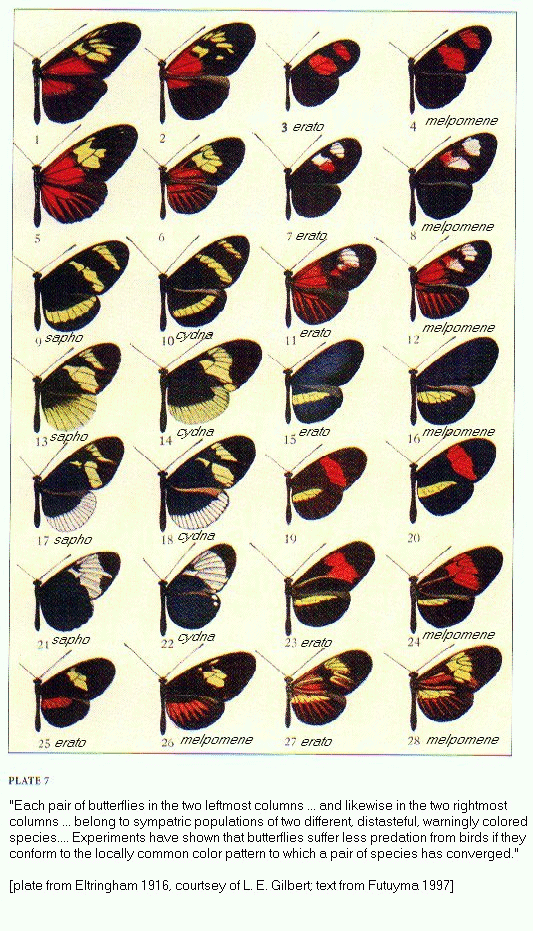
Evolutionists have paid the genus special attention because an uncommon number of its species have "converged," in evolutionary terms. In other words, two different species, both distasteful to predators, over time came to look very similar to one another. This helped predators learn to avoid their particular color and pattern combinations. From the predator's perspective it was "one appearance to avoid" instead of "two appearances to avoid," so each member of the converged pair of species benefited from the predator's greater ease in avoiding them. This special form of convergent evolution is referred to as Mullerian mimicry. There's a chart showing several such converged species pairs at http://www.mun.ca/biology/scarr/Mimicry_in_Heliconius.gif.
Other kinds of mimicry-resulting evolutionary processes -- Batesian, Wasmannian and Peckhamian -- are described at http://www.geocities.com/brisbane_insects/Mimicry.htm.
The Zebra Longwing isn't a member of any such converged- species pair. One ecological curiosity about it, however, is that although its caterpillar form seems able to survive in the forest, the adult form can't compete with other forest species, and is thus fairly restricted to disturbed sites. It's a weedy-area specialist. Though sometimes thought of in the US as a Passionvine Butterfly, here its main host plants are Lantana, Hamelia and Stachytarpheta. The species' distribution extends from deep in South America through Central America, Mexico and the West Indies into the southernmost US.