PLANTS | ANIMALS | ECOLOGY | FUNGI | GEOLOGY | GARDENING | TOOLS
MEXICAN PLANTS & ANIMALS HOME

Excerpts from Jim Conrad's
Naturalist Newsletter
from the March 24, 2007 Newsletter issued from Sierra Gorda Biosphere Reserve, QUERÉTARO, MÉXICO
DON GONZALO'S CILANTRO PATCH
A few weeks ago Don Gonzalo broke up a small patch of land near my casita and sowed cilantro, a pungent herb much used in Mexican cooking. In English often it's called Coriander, but Mexican food has become so popular in the US that now people up there often use the Spanish name. Its technical name is CORIANDRUM SATIVUM. The species is a member of the Parsley Family, in which we also find Cumin, Fennel, Parsnip, Carrot, Celery and other distinguished plants.
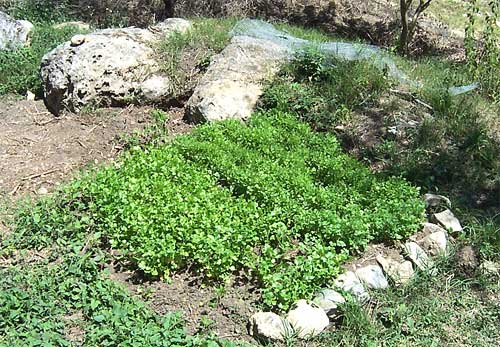
Don Gonzalo's seeds promptly sprouted and my first impression was that he'd sowed his seeds far too closely together. But now I see that he knew what he was doing. The plants are indeed crowded but, as such, they create their own microclimate, keeping individual plants relatively sheltered from the hot, dry-season air and sunlight. These plants aren't bolting and becoming scraggly, as they usually do when up north they're planted well spaced and in straight lines. You can see the Don's shaggy patch below:
I also thought Don Gonzalo had sowed far too much Cilantro, but now I see that he got that right, too. At lunch he opens up his tacos and heavily mulches his bean paste with shredded Cilantro, and he's not the only one who visits the patch. Sometimes the cleaning ladies go down and pick whole handfuls, take a break beneath a tree and nibble on their Cilantro bouquets as if they were bags of popcorn. The office workers sometimes collect it to sprinkle atop their meals and, of course, each day I throw a handful into my solar cooking pot.
There's a page telling more about Cilantro and providing interesting recipes using it at http://www.gourmetsleuth.com/cilantro.htm.
Though Cilantro lies at the heart of traditional Mexican cooking, it was introduced into the Americas by the Europeans. Nor is Cilantro the only European food Mexican cuisine has wholeheartedly embraced. Olive oil, cinnamon, parsley, oregano and black pepper were all introduced by Europeans. They likewise brought in almonds, rice, wheat and barley, and fruit and vegetables such as apples, oranges, grapes, lettuce, carrots, cauliflowers, potatoes (these brought from Peru), and sugarcane. Nor had indigenous Mexicans ever seen horses, cattle, pigs, sheep, goats, or chickens.
On the other hand, Europeans had never heard of Mexico's chocolate, vanilla, corn or chili peppers.