PLANTS | ANIMALS | ECOLOGY | FUNGI | GEOLOGY | GARDENING | TOOLS
MEXICAN PLANTS & ANIMALS HOME

Excerpts from Jim Conrad's
Naturalist Newsletter
from the August 3, 2007 Newsletter issued from Sierra Gorda Biosphere Reserve, QUERÉTARO, MÉXICO
MEXICO'S "CAESAR'S MUSHROOMS"
Of all poisonous mushrooms, members of the genus Amanita are the most deadly. Amanitas are responsible for 95% of all fatalities resulting from mushroom poisoning. With the rainy season's arrival mushrooms are popping up everywhere, and last week near El Madroño I saw two or three Amanita species, the most common and prettiest being the one shown below:
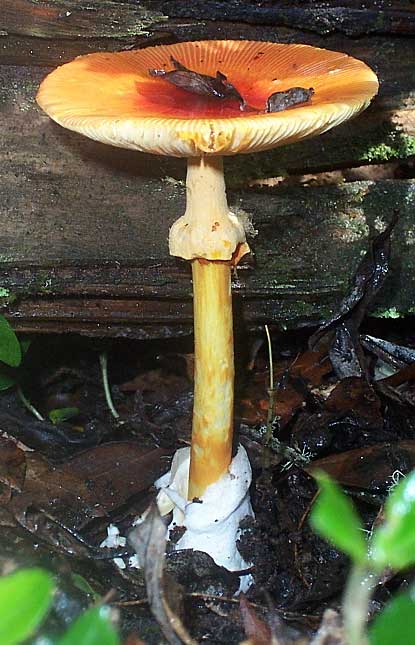
Despite the dire warnings I just gave about Amanitas, the Amanita in the picture is a "Caesar's Mushroom," and "Caesar's Mushrooms" have accounted for the best mushroom-eating I've ever enjoyed, back in Mississippi where during some seasons they were very common. "Caesar's Mushrooms," unlike most Amanitas, aren't the least poisonous.
I didn't collect last weekend's Caesar's because I'm still a bit skittish after being poisoned by Chlorophyllum molybites last summer in Kentucky. Also, I'm putting "Caesar's Mushroom" between quotation marks because there's enormous confusion about which species this fungus really is, as explained at the MushroomExpert.Com website.
I read that in Mexico we may have four or so mushroom species all looking like the one in my photograph and none the "real" Caesar's Mushroom, though that's what they've been called by English speakers. Whatever they're called, since ancient times they've constituted an important part of indigenous Mexican cuisine. By the way, you should see the rainbow of mushrooms available in the huge Merced Market in Mexico City where Indians from all around bring their best finds to sell at the best prices.
Anyway, the only Amanitas I'm going to eat are those looking like our "Caesar's" and served by a local person who knows the local mushrooms, eats some himself, and who likes me.
A good guess is that our mushroom usually would be classified as AMANITA JACKSONII.
By the way, the Amanita in my photograph is a "textbook mushroom" in that it displays so beautifully the important features of "gills" beneath the "cap," a "ring" around the stem, and the stem arising from a "cup." Most mushroom species display only one, two or none of these features. When you're identifying mushrooms it's always important to notice which, if any, of these features are present. More examples of rings and cups are shown on my Mushroom Identification page.
To see lists of mushrooms found during mushroom- collecting trips in central Mexico, and some pictures, take a look at http://www.mexmush.com/finds.htm.