
PLANTS | ANIMALS | ECOLOGY | FUNGI | GEOLOGY | GARDENING | TOOLS
Excerpts from Jim Conrad's
Naturalist Newsletter
from Jim Conrad's Nature Notes issued from California's Sierra Nevada Foothills in 2005:
PACIFIC MADRONE
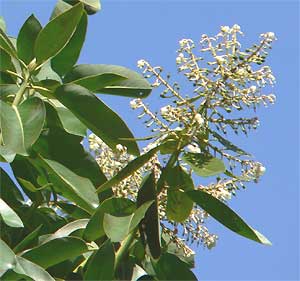 Pacific Madrone, Arbutus menziesii, is an abundant, small tree with leathery, evergreen leaves 3-6 inches long, flowering in early spring. At the right you see how clusters of white, globular flowers form at the end of branches. The tree is easy to identify because its trunk is smooth, reddish-brown color, and has a tendency to peel into thin, irregular sections exposing greenish-brown inner bark. In the fall it becomes even easier to identify because of its bright orangish-red, spherical but bumpy fruits. The various manzanitas are similar but they are bushes typically around 3 feet high and most of them have rounder leaves than those shown at the right.
from the July 5, 2009 Newsletter, issued from the Siskiyou Mountains west of Grants Pass, Oregon:
THE MADRONES' NEW LEAVES
This year Oregon's hot, dry season arrived late but finally we're regularly getting afternoon temperatures into the 90s. The air is so dry, however, that high temperatures here aren't nearly as daunting as much cooler temperatures with high humidity elsewhere.
My "summer feeling" is associated with high heat and humidity, and much lushness and greenness. Here the air's dry crispiness subverts that feeling. Our roadsides and forest floors even evoke "fall feelings" because they're littered with large, leathery Madrone leaves. Madrones are ubiquitous, small trees with distinctive smooth, red bark. Bearing green leaves throughout the year, Madrones have been dropping a few leaves ever since I arrived, but the rate of drop recently has increased dramatically. In late afternoon when hot, dry winds stir, sometimes there's even a little flurry of falling Madrone leaves.
Nowadays most Madrones bear both shiny, new green leaves, and older, yellowish ones, as you can see below:
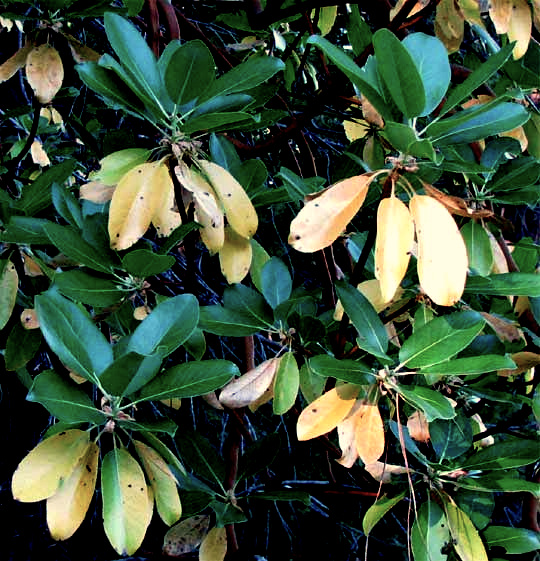
Often when trees issue green leaves before dropping their old ones they actively recycle nutrients from the fading leaves into the new ones and I'm guessing that that's happening here.
from the August 2, 2009 Newsletter, issued from the Siskiyou Mountains west of Grants Pass, Oregon:
EXFOLIATING MADRONE TRUNKS
Last weekend as I camped on a dry ridge mostly populated with madrones I witnessed something amazing. As a very dry wind approaching 100 degrees filtered among the trees, reddish-yellow flakes ranging from postage-stamp size to shreddings long as my arm showered from the madrones' trunks.
People talk about madrone trunks having three kinds of bark. One bark is "normal" -- dark, woody, scaly -- but in many places, especially on younger wood, this opens up to reveal a reddish bark beneath it, and then sometimes the reddish bark opens up show a pale green bark beneath it. The green bark isn't "inner bark," or the cambium layer. It's just a third layer of bark. You can see a trunk near my trailer showing all three below:
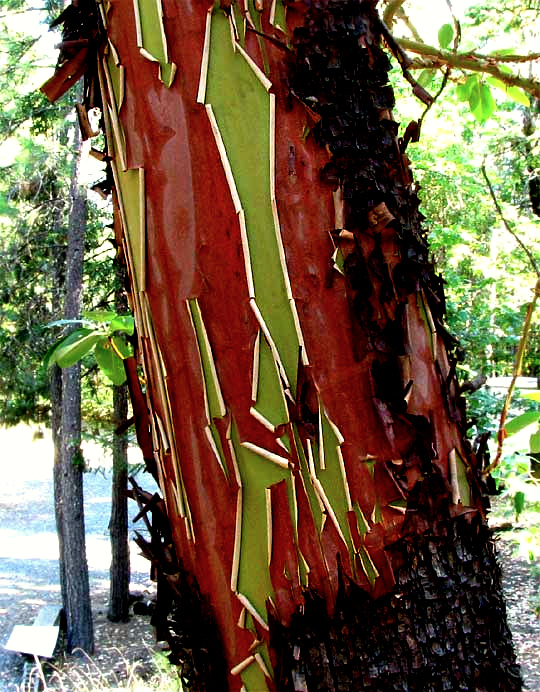
The confetti showering around my tent last weekend was the "middle bark" peeling off, the red one with curled, tan edges in the picture. When a stiff breeze came along it was like a heavy leaf-fall in autumn, except that some of the "leaves" were quite large.
On several trees with large patches of reddish bark exposed I was able to peel off thin, pliable, somewhat moist sheets a foot wide and two to three feet long. A square sheet pressed in a book dried to an admirable but somewhat brittle sheet of "paper" that could have been written on easily.
Why do madrones have three kinds of bark, with the reddish middle one exfoliating so spectacularly at this time of year? I can't find any informed answer. I'm going to make a wild guess, though:
This is happening exactly when it's so hot and dry here that I'll bet the trunks are actually shrinking in size. Maybe being able to shed bark from those large, newer growth areas is an adaptation enabling the trunk to shrink in these spots without the bark buckling. Buckled bark might provide entry points for insects and disease organisms.