
PLANTS | ANIMALS | ECOLOGY | FUNGI | GEOLOGY | GARDENING | TOOLS
Excerpts from Jim Conrad's
Naturalist Newsletter
from the the July 13, 2008 Newsletter, written near Natchez, Mississippi:
RIPE FIGS
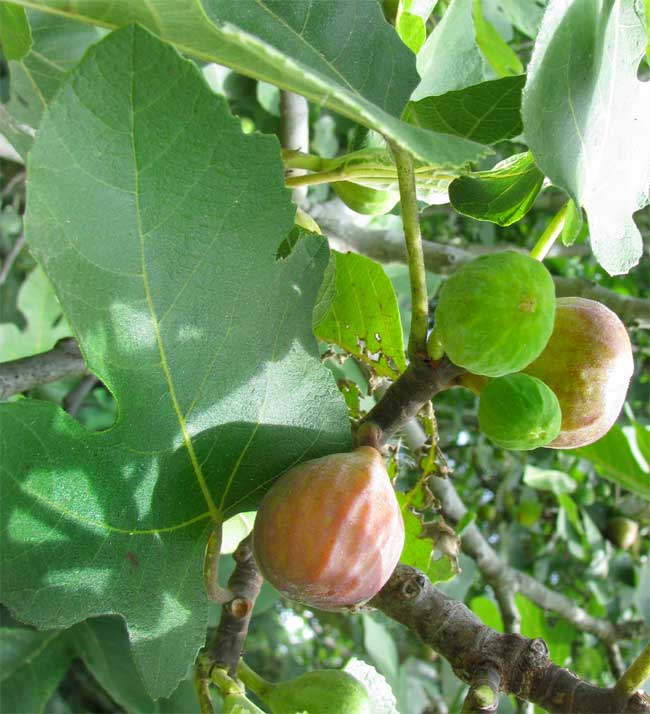
At the house of Karen's mom in Natchez I was invited to see the big fig tree loaded with figs. You can see some of those figs above.
The figs' voluptuous roundness, the ripe ones' handsome brownness glistening in the sunlight, their yielding touch, sweet taste, many figs with bird- peckings attesting to their desirability... In fact birds will get the vast majority of those figs, for once they get a taste they'll return again and again until they're all gone. What a gift to have such homey, mellow, good-humored fig thoughts as we rolled out of town.
Voluptuous, yes, that's the word, a sweet, ripe fig right off the tree melting in your mouth transcends the mere act of eating in the everyday sense. It's as if the Creator goes out of Her way to remind us of the bounty and beauty that sometimes come into our lives if we wait patiently and have sense enough to recognize bounty and beauty when they come along.
Last Monday, heading north up the Trace with pink Crape-Myrtle blossoms aflame on roadside bushes hoary with tangled Spanish Moss I glowed with fig feelings, inside and out, deeply satisfied to be on the road afterglowing from such roundness, sweetness, stickiness, the yielding flesh, the fruits' demure placement among rough, sun-gathering, profoundly green leaves...
from the July 15, 2012 Newsletter, written near Natchez, Mississippi:
THE FIG-FLOWER SITUATION
The last two weeks have been fig season around here, which means that I've eaten two or three figs each day somehow overlooked by the birds. Now the figs are just about all gone.
In the Yucatan we had several fig species, all producing small, spherical figs, and the trees often grew to gigantic proportions. The fig species I'm talking about here is the Common Fig, FICUS CARICA, native to the Mediterranean region. It's a small tree with soft, sweet, golfball-size, pear-shaped figs.
Fig "fruits" are not fruits. When you bite into a fig you can see how unfuitlike the fig's interior is, as shown below:
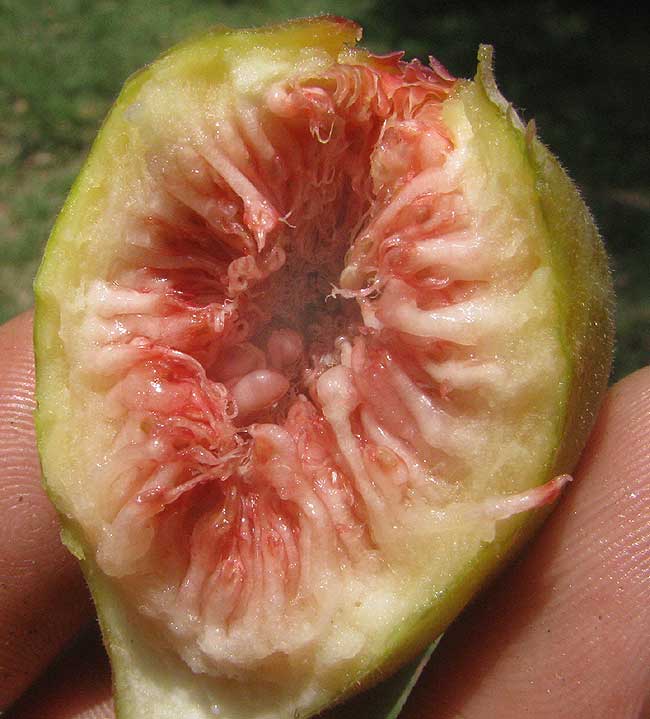
The fig "fruit" is a fruiting structure called a syconium. Imagine a plate with many tiny flowers growing atop it, packed very close to one another. Now fold the plate's edges up to form a U, which brings the flowers to the inside of the U. Now bend in the top of the U until it's almost an O, but with a tiny hole in the O's top, the ostiole. This places all the flowers inside the O. That's a syconium. In the above picture, the pinkish, spaghetti-like structures attached to the fig wall, the receptacle, and growing inward toward the fig's center are flowers or the remains of flowers.
In Nature, a tiny "fig wasp" enters the ostiole at the fig's top and walks around inside atop the flowers, pollinating them.
Common Figs come in two sexual forms. Trees producing edible figs like ours are all female trees. Therefore, in the above picture, notice that the spaghetti-like structures bear spherical enlargements at their tops. Those spheres are ovaries. Immediately beneath the ovaries in some cases you can make out toothed calyxes just as in normal flowers. Below the calyxes the slender stems are pedicels, also exactly as in normal flowers.
The female flowers in our figs don't get pollinated and produce seeds, so in the figs I've been eating there's none of the "grittiness" found in some store-bought fig products.
In fact, Common Fig sexuality is pretty complex. A good place to delve more deeply into it is at http://waynesword.palomar.edu/pljun99b.htm.
from the July 14, 2002 Newsletter, written near Natchez, Mississippi:
FIG PICKING
This week figs began ripening at full speed. There were a few last week, but this week each morning when I crossed the bayou the first hour or so was spent just picking figs.
It's not a bad way to start a day's work. I see a plump, purplish fig, place its stem between two of my fingers, give a tug of a certain strength, and if the fig is properly ripe it breaks off. That "tug of a certain strength" is something you have to learn; no book can teach it. I am always tickled to know something a book can't teach.
It's too hot to wear more than a pair of shorts and a sweatband so the trees' rough leaves scratch against my body and the brittle limbs poke at me. After a while I get good and sweaty and itchy, and my hands are all gummy from the figs' latex. This is "deep immersion" and in a strange way it feels good. When I'm inside the trees with morning sunlight slanting in from the east, I feel like a goldfish in a brightly lit little aquarium thick with seaweed. And the sweat and itching make the stretched-for fig a little sweeter.
from the December 14, 2003 Newsletter, issued from near Natchez, Mississippi:
FIG TREE STEM CUTTINGS
Recent hard freezes have left local Kudzu terrains looking like parking lots knee deep in brown, crumpled wrapping paper. Another consequence of this cold weather is that now is the time to take "stem cuttings" from certain kinds of trees. The idea is to manage the cuttings in such a way that by next spring they'll have developed roots, and then what once was a twig can be transplanted as a rooted sapling.
The other day neighbor Karen Wise picked me up and we went to an overgrown, abandoned homestead she'd discovered way out in nowhere, where an old fig tree struggled with other trees overtopping it. We filled Karen's little van with large branches removed from the fig tree, returned here, and then with razor-sharp knives removed twig tips up to a foot long. We cut the stems diagonally in order to expose more cambium area, because future roots will arise only from that very thin region right below the bark. Then we stored the sticks upright in buckets with water in the bottom of them.
Later I worked up a plot of new garden space, applied rooting compound to each twig's cut end, and planted 315 of them an inch or so deep and half a foot apart. The rooting compound contained 0.1% Indole-3-butyric Acid, which is a synthetic auxin. In nature, auxins are plant hormones. Many kinds of auxins enable plants to things such as orient their stems toward sunlight and have their roots respond to gravity. Synthesized Indole-3-butyric Acid mimics the natural auxin Indole- 3-acetic Acid, whose job is to initiate root growth.
We have a book here suggesting that fresh stem cuttings should be tied into small bundles, then buried over winter in a can of damp vermiculite. The rooting compound should only be applied in the spring, it says, when the cuttings are set out. This author, like so many, is a Yankee with gardening experience "in the northern mountains of Vermont." I'm guessing that here we should skip the can of damp vermiculite, for our "deep winter" is surely warmer than his "early spring." It's always a good idea to check where your horticultural guru lives before accepting his or her advice.
from the April 25, 2004 Newsletter, issued from near Natchez, Mississippi:
FIG TWIG CUTTING UPDATE
You may recall that last fall we cut over a hundred fig twigs from an old, abandoned fig tree, applied powdery rooting-auxin to the cut and stuck the twigs into the ground.
The results of that experiment are that about a third of the twigs rooted and currently are sprouting shoots and leaves. I think that most of the twigs were killed by the cold. I'd also planted some well rooted fig saplings in more exposed areas and they all died from what appears to be freezing. If I were to conduct this experiment again, I'd cover the twig bed with straw mulch.
Seeing how easy it is to acquire fig saplings, I just don't understand why every empty corner of our landscape, especially people's backyards, isn't graced with this wonderful plant.