
PLANTS | ANIMALS | ECOLOGY | FUNGI | GEOLOGY | GARDENING | TOOLS
Excerpts from Jim Conrad's
Naturalist Newsletter
from the February 2, 2009 Newsletter, issued from the forest near Natchez, Mississippi; elevation ~400ft (120m), ~N31.47°, ~W91.29°:
WINTERY ELM MEDITATION
During my morning campfires I enjoy a pretty view across an abandoned orchard into the wintry woods, and right in the middle of my view stands the tree shown below:
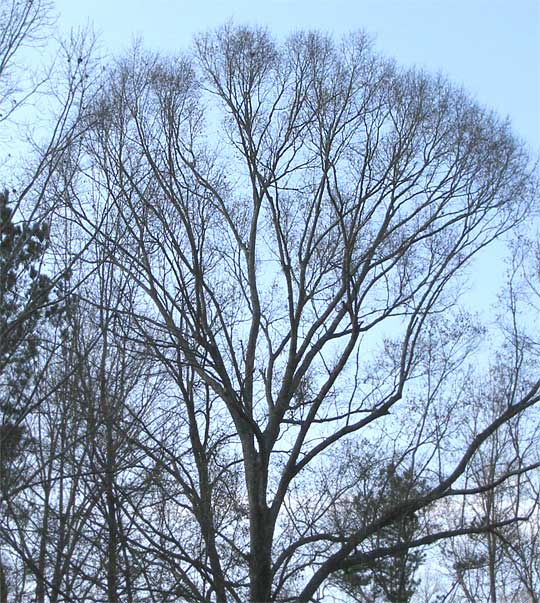
That's an American Elm, ULMUS AMERICANA, and I love sitting next to my campfire gazing into that tree's branches.
For, the American Elm's graceful, ever-dividing manner of branching beautifully expresses the philosophy behind the evolution of life on Earth, and lots of other complex systems that evolve slowly and methodically. When we speak of the "Phylogenetic Tree of Life," we assume a single primal ancestor at the root, then through time that ancestor gave rise to new forms of life, then those forms produced yet new forms, on and on through time until at the wispy tips of the terminal branches there reside today's species.
There's a special word used for the branching system of trees such as the American Elm whose limbs so gracefully branch into numerous subdivisions, then those branch and those branch again, on and on. They're said to "deliquesce." An American Elm's branching pattern is "deliquescent."
In contrast, a tree such as a spruce with a single, undivided trunk with lateral branches jutting out from the trunk's side is said to display an "excurrent" branching pattern.
from the February 16, 2009 Newsletter, issued from the forest near Natchez, Mississippi; elevation ~400ft (120m), ~N31.47°, ~W91.29°:
AMERICAN ELM FLOWERING
A couple of weeks ago I featured flowers of the Winged Elm, Ulmus alata, and now I have a picture of flowers of the American Elm, ULMUS AMERICANA, so you can see the differences. The Winged Elm's flowers are shown at http://www.backyardnature.net/n/w/wing-elm.htm.
The American Elm's differently arranged flowers are shown below:
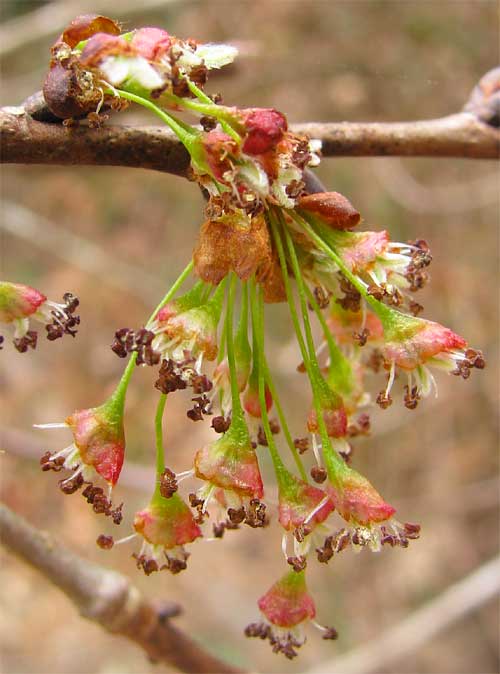
The two species' flowers share very similar structure but you can see that the American Elm's blossoms dangle at the end of very long flower stems, or pedicles. Also, notice that Winged Elm flowers branch from a central axis or rachis extending from the flower bud, while American Elm Flowers arise individually from the bud, like long-stem roses from a small, round goblet -- they're "fascicled" as opposed to Winged Elm flowers being arranged in a raceme, or "racemose."
from the March 22, 2005 Newsletter, issued from near Natchez, Mississippi:
A HEALTHY AMERICAN ELM
As I type these words a gentle shower of little green items is falling not far away. Those items are the fruits of the American Elm, ULMUS AMERICANA.
I'm especially happy to see this healthy, lustily reproducing tree because throughout much of the American Elm's distribution it's been killed off by a number of diseases, particularly the Dutch Elm Disease, caused a fungus introduced into the US from Europe in 1930, in a shipment of logs. Up at my old Kentucky home it's unusual to find large, healthy American Elms. In many areas the species has been completely wiped out. I've found several healthy trees around Natchez, however. Maybe it's because American Elms here are relatively uncommon, so their low population density keeps them from being infected by sick neighbors.
The most common elms around here are the Winged Elm and Slippery, or Red, Elm, which are not attacked by the Dutch Elm Disease. Therefore, if you find a healthy elm, you may want to know whether it's one of those species, or an American Elm.
It's fairly easy to distinguish the species, based on their fruits. All elm fruits are flattish, papery, wafer- like things called samaras. You can see the American Elm's fruit and other identification features at www.cnr.vt.edu/dendro/dendrology/syllabus/uamericana.htm.
Note that the American Elm's samara is greenish, about half an inch long, and is hairless on both faces, but its edges are conspicuously fringed with white cilia. The samaras of our two other common species have hairs on their flat faces.
You can read a lot more about American Elms here.