
PLANTS | ANIMALS | ECOLOGY | FUNGI | GEOLOGY | GARDENING | TOOLS>
Excerpts from Jim Conrad's
Naturalist Newsletter
from the the April 19, 2015 Newsletter, issued from Calhoun, McLean County, Kentucky, USA:
WILD CANADA GEESE
When I was a kid, seeing big Vs of migrating Canada Geese flying overhead was exciting. People would run into the house to tell others about it, and everyone would go outside to see them, and listen to the honking. Now when I Google the keywords "Canada Geese Kentucky," the first page to turn up is entitled "Canada Goose Control."
In other words, nowadays it's no big deal to see Canada Geese. In fact, many regard them as pests, for Canada Geese, BRANTA CANADENSIS, are adaptable birds, and over the years they've adapted their behavior to take advantage of human changes in the environment. Now they're commonly found in city parks, golf courses, suburban lawns and such places, often produce messes with their poop, are not above defending their spaces with hisses and pecks, and often don't migrate.
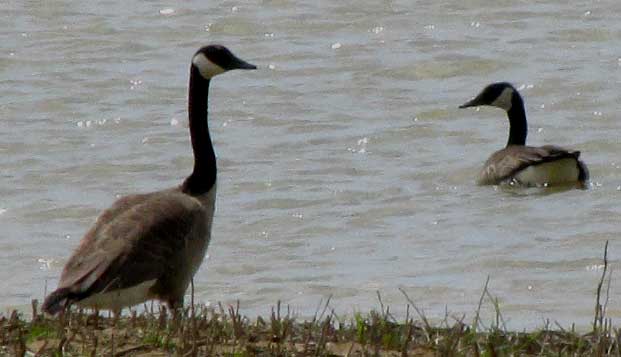
But, as with humans, there are still individuals and isolated populations of Canada Geese sticking to the old ways, and they are as wild and natural as ever. I think I saw a couple of such birds this week in a flooded soybean field in the bottomlands along our western Kentucky Green River. That's them at the top of this page.
Over the years, not only has Canada Goose behavior changed, but also our concepts of what a Canada Goose is. Currently about seven Canada Goose subspecies are recognized. Earlier four subspecies of exceptionally small geese also were thought of as Canada Geese, but now they're regarded as Cackling Goose, Branta hutchinsii. The geese in our picture are too large, and their beaks are proportionally too big, to be Cackling Geese. Canada Geese also have established themselves on other continents and can be expected to be adapting to those new environments, too.
Whatever Canada Geese are doing in the rest of the world, and in suburbs and parks beyond our local fields and swamps, I was glad to see the birds our picture, and I'm glad that they showed every sign of not trusting me, and of being ready to escape if I came an inch closer.
from the the October 14, 2001 Newsletter, written near Natchez, Mississippi, USA:
GEESE JUST BEFORE DAWN
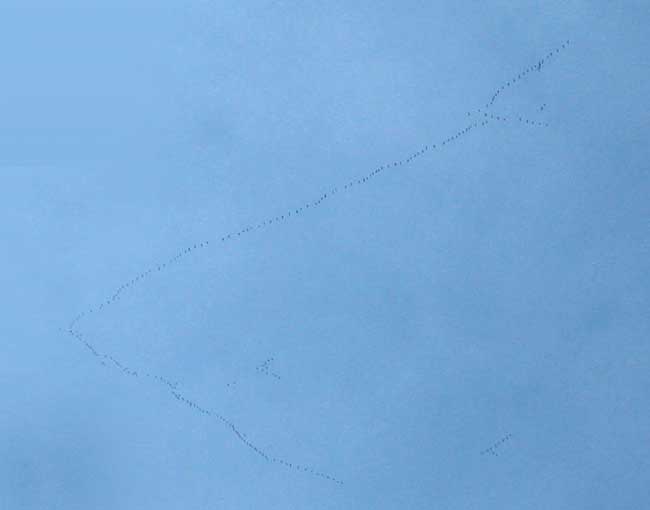
Friday morning, about an hour before the first hint of dawn, I heard a large number of Canada Geese flying overhead. This species spends its summers in Canada and the US Northwest, and it overwinters in the southern US and farther north along the coasts. Their overwintering habits have actually changed during recent history because so many manmade lakes have been built, and people feed them through the winter. All winter I'll hear and see them here, for St. Catherine Creek National Wildlife Refuge, once part of Laurel Hill Plantation, now occupies the land between the plantation and the Mississippi River, and that refuge is a wonderland of swamps, streams and flooded fields -- prime habitat for Canada Geese.
Lying snugly within my Kentucky quilts, Friday just before dawn I tried to detect what emotional state the geese were expressing in their calls, though I'm not sure at all that a human can do that. I could certainly imagine how beautiful it must be to be a goose flying high inside a great V in the black sky, the fellow members of my family/flock/tribe sailing with me, the silvery Mississippi slowly gliding by below and on my right, the air around me suddenly growing balmy and friendly after flying for so long in the biting chill behind the cold front that at that time lay just to the north of us. However, it seemed to me that what I heard in their voices was anxiety, a certain nervousness. It was very dark, with clouds masking the moon and, really, it's hard to imagine that they could even see the Mississippi. Being so high and needing to land, but not being able to see much of what lay below...
from the September 7, 2006 Newsletter, Issued from Polly's Bend, Garrard County, in Kentucky's Bluegrass Region:
CANADA GEESE AT DAWN
Last spring I mentioned how some mornings a small flock of flying Canada Geese emerged from the dense, white ribbon of fog pooling atop the Kentucky River nearly completely encircling Polly's Bend's peninsula, and noisily sailed low over my campfire breakfasts. I've heard them on and off all summer. Lately they've been appearing regularly, but now the flock is a lot larger. I'm guessing that it's the same birds from this spring, now accompanied by this year's new crop of juveniles. They honk even louder now, as you might expect of parents up there telling kids to keep up and pay attention.
The distribution map for Canada Geese in my falling- apart, copyrighted-1966 field guide to the birds shows Canada Geese spending their summers in Canada and part of the northwestern US, overwintering in the southern states and along the coasts, and in this part of Kentucky and most of the rest of the US appearing only during migration. Obviously the map is out of date. Everyone knows that in much of the US Canada Geese populations remain year round.
When I was a kid in western Kentucky, our spring- and fall-migration sightings of Canada Geese always provided a thrill, for it was something majestic touching our humdrum lives. Now many Americans associate Canada Geese with the messes they make when overfed and staying in once place. The world of Canada Geese is rapidly evolving, accommodating human geography and human destruction of natural habitat. Canada Geese are almost like the Southern Hornets whose nests, until now seldom larger than basketballs and holding only one queen, are showing up half the size of a car, and with up to 70 queens.
Perdue University provided a good but possibly outdated introduction to Canada Geese. On that page I found a review of various races of Canada Geese -- dwarf, normal, and giant ones. The normal and dwarf races are supposed to nest only in the far north. The giant race, with a wingspread of up to six feet across, migrates only locally, so any goose family spending the summer in this area is supposed to be a Giant Canada Goose. The ones I'm seeing don't look that large, so I wonder if maybe the races are blending.
On the topic of global warming affecting bird distribution an article in National Wildlife Magazine begins:
"By the late 21st century, says scientist Jeff Price, the distribution of North American birds will almost certainly look nothing like the species' range maps found in today's popular field guides. Some startling possibilities: State birds such as the Baltimore oriole (Maryland) and black-capped chickadee (Massachusetts) will have vanished from their official residences; there will be painted buntings in southern Minnesota but no bobolinks... "
from the September 27, 2009 Newsletter, issued from the Siskiyou Mountains west of Grants Pass, Oregon:
200+ MIGRATING GEESE
Last Thursday several big, high-flying, noisy flocks of geese, Canada Geese I suppose, flew over us headed exactly southward. I counted over 190 birds a couple of times before my cataract-wracked eyes, which can see double images with each eyeball, confounded me. It was well over 200 birds, though.
Some local Canada Geese hang around year-round, being fed, but these flying-over flocks were old-time, conservative birds seeking their traditional foods on overwintering grounds far to the south, the way good Canada Geese are supposed to.
It's funny how we can admire conservatism in something like a goose, but so often find it aggravating and maladaptive in our own species. Well, goose society doesn't evolve the fast way human society does so mindless conservatism serves geese better than humans.