
PLANTS | ANIMALS | ECOLOGY | FUNGI | GEOLOGY | GARDENING | TOOLS
Excerpts from Jim Conrad's
Naturalist Newsletter
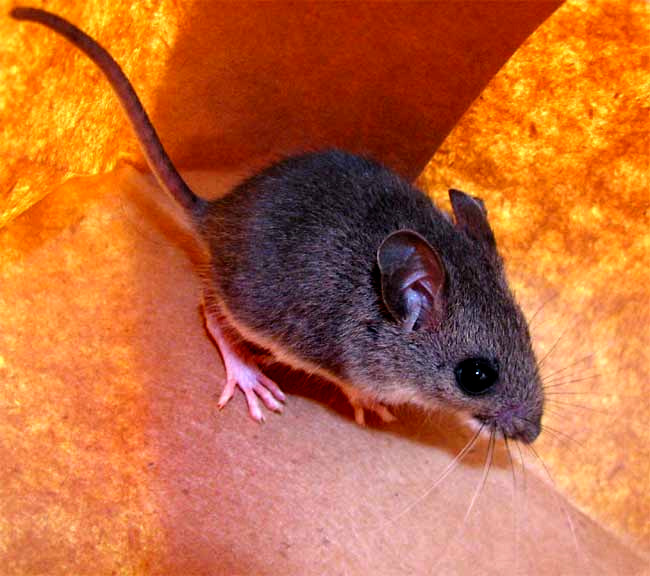
from the March 23, 2009 Newsletter, issued from the forest near Natchez, Mississippi; elevation ~400ft (120m), ~N31.47°, ~W91.29°:
WHITE-FOOTED MOUSE IN A BAG
When a certain thumping followed by furious scratching of tiny paws arose from inside a paper bag behind my computering spot in Karen's laundry room I knew instantly what it was, for during my hermit years near here I'd heard the sound a thousand times: a snoopy, adventurous, hungry White-footed Mouse, PEROMYSCUS LEUCOPUS, had gotten himself into a hard place to get out of and was trying to jump out, again and again. When it happens in the middle of the night in a tiny trailer, your brotherly feeling toward other animals is sorely tested. You can see the bag-imprisoned individual interrupting my meditations the other day, above.
White-footed Mice must be among the most successful of all mammals. By successful I mean that they enjoy a large distribution, from Nova Scotia and Saskatchewan south through most of the eastern US, and down through eastern Mexico all the way to the Yucatán. Around here I think every brushpile, every woods edge, every acre of woodland disrupted by logging, every shed, every abandoned car and most houses at least occasionally host White-footed Mice.
Back in my hermit days I invested a lot of time trying to catch them without hurting them. My most successful trap consisting of placing a foot ruler delicately balanced so that nearly half of it extended beyond my table's top, to out over a bucket below. At the end of the ruler jutting into space I'd leave a cornbread crumb. The bucket needed about half an inch of water in it. Nearly always, soon as it was dark, the ruler and a mouse would tumble into the bucket, awakening me. Then I'd carry the mouse outside and coax him into a container so I could carry him a mile or so away during the next morning's jog. The water in the bucket was necessary because a dry White-footed Mouse can jump unbelievable heights but a wet mouse can't jump over a bucket's rim. You don't want it deep enough for him to drown, though.
Despite my many jogs carrying mice a mile from my trailer, I never seemed to reduce the mouse population. Now I learn that in experiments in which White-footed Mice were captured and let go two miles away the mice found their way back home. This and much more information on the species' behavior is available here.
Actually, there's another almost identical but slightly larger mouse in this area, the Cotton Mouse, Peromyscus gossypinus, which I can't differentiate without precise measurements and weighing. I'm just guessing that that's a White-footed Mouse in the bag because of the White-footed's general fame as one of the commonest of all small mammals wherever it occurs. In other words, "White-footed" is the best educated bet.
from the February 23, 2009 Newsletter, issued from the forest near Natchez, Mississippi; elevation ~400ft (120m), ~N31.47°, ~W91.29°:
A MOUSE'S HARELIP
The other day I found a White-footed Mouse, PEROMYSCUS LEUCOPUS, in the backyard, apparently killed by one of several housecats who roam the area. While I had the dead mouse I looked him over, admiring some of the wonderful adaptations that make this such an abundant animal around here. For example, take a look below:
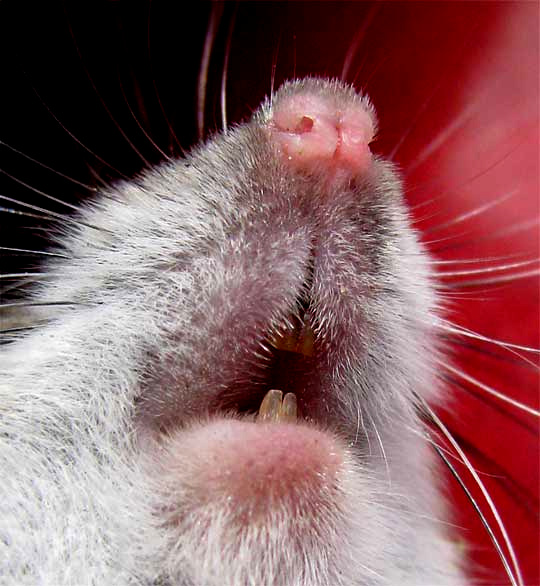
Especially interesting was the deeply cleft upper lip. I hadn't realized that the cleft continues clear up into the nose.
Experts writing on the internet speak of split lips helping animals to manipulate food -- they're "prehensile" lips working together like two little fingers coordinating with the incisors and tongue. Cleft upper lips must help animals a lot because they appear in many fairly unrelated species -- manatees, camels, llamas, sheep (but not goats), cats, rabbits, tapirs, and more.
Rabbit expert Pam Enve explains that rabbits wiggle their noses not only because wiggling causes an increase in airflow, which enhances their ability to smell, but also because it "separates the split in their upper lip and this helps to moisturize the air and this ... also helps to improve their ability to smell because it keeps their sinus's from getting clogged." It seems like she's saying that the split channels mouth saliva to the nose, where it moistens incoming air.
Whatever the reason for that cleft reaching clear into the nose, when I saw the little mouse's finely detailed mouth and nose the main impression really wasn't that I was seeing great adaptations, but rather that this cat-killed little creature was a hairy- faced, pink-skinned little brother, so different but also so similar to myself, and I felt bad about his pointless death.
from the December 16, 2012 Newsletter issued from the valley of the Dry Frio River in northern Uvalde County, southwestern Texas, on the southern border of the Edwards Plateau; elevation ~1750m (~5750 ft); N29.62°, W99.86°; USA
WHITE-FOOTED MOUSE
At a neighbor's house here a mouse with a white underside turned up stretched out on the sidewalk either dazed or dead from unknown causes, I was curious whether it might be my old Mississippi buddy-species. That's him below:
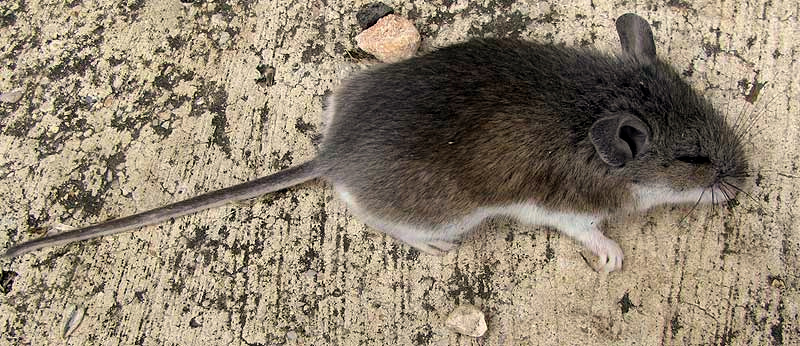
The online Mammals of Texas by Davis & Schmidley at https://www.depts.ttu.edu/nsrl/mammals-of-texas-online-edition/ lists 33 mouse and rat species in the family Heteromyidae just for Texas, and several of those species have white undersides. The book says that White-footed Mice in Texas are most easily confused with Cotton Mice and Deer Mice. However, Cotton Mice are smaller, have a relatively shorter body and brighter color than White-footed Mice, and Deer Mice have tufts of whitish hairs at the bases of their ears and sharply bicolored tails -- white below and dark above. It also says that the White-footed Mouse's tail is about 43% of the body's total length. I measured the tail and body length of our mouse and, by golly, the tail figured out to be exactly 43% of the body's length! The other mice species have tails proportionally of different lengths.
Our White-footed Mouse turned out to be mysteriously dead. His demise won't make much of a dent in the local population, however, since now I know that also in Texas the species is abundant in many habitats, feeding mostly on seeds and especially acorns and pecans, which also are abundant here. Young females mature sexually at the age of 10 or 11 weeks and may bear their first litters at the age of 13 or 14 weeks, so females born in the spring can themselves rear one or two litters before winter sets in. However, White-footed Mice seldom live to be more than 18 months in the wild because so many predators feed on them.
There's a White-footed Mouse in the cabin too smart to fall for any of the peanut-butter-smeared live traps I've devised for him. He's almost become a pet, like the ones back in my hermit camp.
from the July 8, 2001 Newsletter, issued from near Natchez, Mississippi:
WHITE-FOOTED MOUSE
It's too bad that when most people think of mice they visualize a House Mouse. The House Mouse is just one mouse species among many, plus it's an introduced species from Europe. Really, it is a "weed species" among a rainbow of wonderful native rodents.
I'm thinking about mice now because for the last couple of weeks my trailer has hosted the most recent of a long series of White-footed Mice, and this one I have not been able to trap. Of course I didn't want to hurt him or her so I tried all of my usual live-trapping methods. But this was a smart mouse and simply refused to enter the various one-way doors and snares I contrived. TWICE I cornered the critter and both times as I was driving him toward the open door in a flash he turned toward me and either ran between my legs or jumped onto me, then onto the floor behind me.
Finally this week as I worked at the computer I heard the little intruder inside the toolbox beneath my sleeping platform. I sneaked over, closed the box, took the box outside, opened it, and there was my guest looking with its enormous eyes right into my eyes -- for about half a second, before it turned, leaped a good four feet onto my elevated fireplace, and disappeared.
White-footed Mice are amazing jumpers -- can jump right out of a large bucket. Also they are handsomely rusty-gray above and white below, with huge eyes and ears -- very unlike the squinty-eyed, gray House Mouse.
White-footed Mice are abundant here, in every brushpile, every outhouse, all through the woods and fields. The species is native over a vast region of the eastern and central US, deep into Mexico. It eats mainly seeds, nuts and insects, and each individual has a home range of from a half to 1.5 acres, with 4-12 individuals occurring per acre.
The unfortunate thing is that they also carry ticks infected with Lyme Disease, and we live in a hot-spot for that. Both Kathy Moody, the plantation manager, and myself contracted Lyme Disease a couple of springs ago when ticks were especially bad.
from the December 23, 2001 Newsletter, issued from near Natchez, Mississippi:
SMOKE-MAKING MOUSE
Tuesday evening I was asked to make a rare trip into town, to drive back a plantation truck that had been in the garage. I have not driven anything in over a year so this was going to be some practice. As we were unlatching the gate to leave the plantation, smoke began filling the pickup's cab. It smelled of burning straw and I knew that we were once again rubbing shoulders with White-footed Mice, the species that so often sets up residence inside my trailer.
We turned the engine off and the smoke stopped. Upon returning to the cab we found a dead mother mouse on the floor. Probably she had gnawed the insulation off the wiring behind the dashboard, and when the lights had been turned on not only had the naked wires sparked, causing her straw nest to smolder, but also she had been electrocuted.
The next day living baby mice began dropping from behind the dashboard. But that appears to be the Creator's guiding principle for all living things. The Creator cares much less for individuals than for the perpetuation of the species. And though this little mouse-family has gone extinct, the species to which it belongs well may stand a better chance of being around a thousand years from now than our own.
You just have to admire a little being so adaptable that it can be content raising a family in the noodly world behind an old pickup truck's dashboard. And Mama Mouse would have succeeded, too, if the truck had sat unused just a few more days.