
PLANTS | ANIMALS | ECOLOGY | FUNGI | GEOLOGY | GARDENING | TOOLS
Excerpts from Jim Conrad's
Naturalist Newsletter
from the August 25, 2013 Newsletter issued from the Frio Canyon Nature Education Center in the valley of the Dry Frio River in northern Uvalde County, southwestern Texas, on the southern border of the Edwards Plateau; elevation ~1750m (~5750 ft); N29.62°, W99.86°; USA
TOBACCO HORNWORM
My tomato crop this year has been disastrous. Most plants, though now up to shoulder high, haven't produced a single tomato. The reason may have been that we didn't have the right cultivar, for most tomato cultivars require a night temperature between about 59° to 68°F (15°-20°C). With night temperatures much below or above that critical range, fruiting is reduced or absent. We haven't had a night temperature of 68°F or below for months.
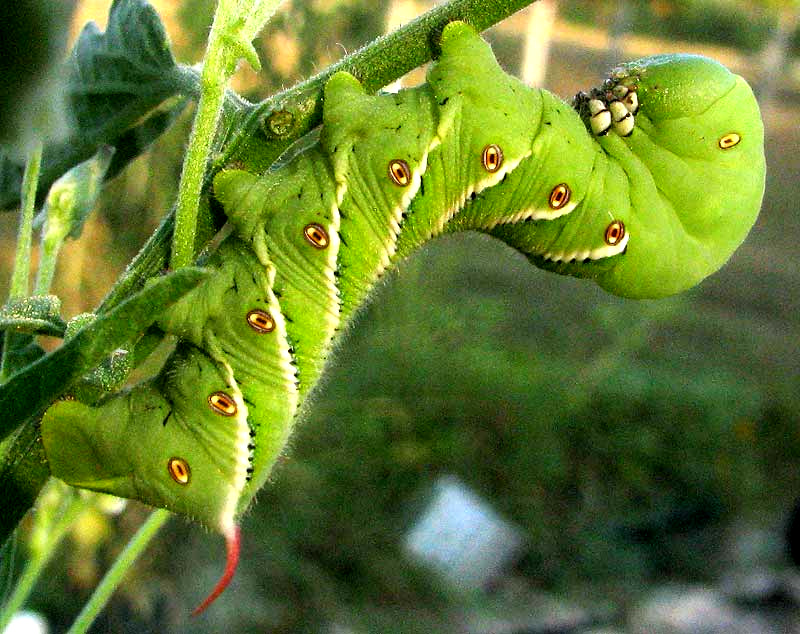
Therefore, I wasn't too upset to find that one of my most robust but tomatoless plants was being devoured by several hornworms, one of which is shown at http://www.backyardnature.net/n/13/130825hw.jpg.
Despite our 2½-inch long (63mm) hornworm feeding on a tomato plant, this is a Tobacco Hornworm, MANDUCA SEXTA. Similarly plump, green, horn-butted and closely related Tomato Hornworms are common throughout most of tomato-growing North America, though in the US Southeast Tobacco Hornworm tends to be more common. In fact, I can't recall seeing a Tomato Hornworm, but in Kentucky and Mississippi I've hosted many Tobacco ones.
Notice that the white stripes on our Tobacco Hornworm are simple slashes, like a /. This is different from the white side markings on Tomato Hornworms, which are like lying-down Vs, like >>>>. One way to remember which is which is to keep in mind that the Tobacco Hornworm's white markings are straight lines like cigarettes, while the Tomato Hornworm's are Vs, for tomato vines. Also Tobacco Hornworms tend to have red spines at their rears, while Tomato Hornworms bear black ones.
Both Tobacco and Tomato Hornworms, after passing through a pupal stage in the ground, metamorphose into somewhat large, grayish-brown moths with stout, narrow wings about four inches across (10cm). The forewings are much longer than the hind ones.
While such a nice caterpillar picture stands before us it might be worthwhile to review the leg situation. Notice that immediately behind the caterpillar's head at the picture's right there are six short, sharp-pointed, white but black-banded items. Those are "thoracic legs" corresponding to the six legs of the adult. The large, green, succulent-looking appendages grasping the tomato stem are "abdominal prolegs," which are missing in the adult stage. At the rear end, below the red spine, those appendages are "anal prolegs." Prolegs aren't "real" legs -- they're not jointed like an adult insect's leg composed of coxa, trochanter, femur, tibia and tarsus. Prolegs do have their own musculature, but much of a prole's movement is a matter of hydraulics, not muscles.
The "eye" markings along the side mark air-holes called spiracles.
from the July 6, 2003, issued from near Natchez, Mississippi:
TOBACCO HORNWORM
I only have four tomato plants in my new garden, so when one morning I saw that some leaves on one of the plants had disappeared, I knew I had trouble. Searching my plant I found what I expected: the glossy, green, finger-sized hornworm shown below.
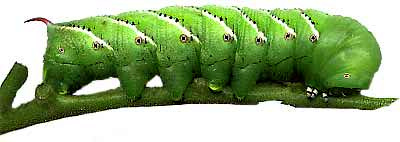
I'd been thinking of suckering my tomatoes, so each day I began placing my hornworm on a sucker I was glad to be rid of, and each night he'd eat two or three sucker leaves. After about four days the caterpillar was over 3 inches long (75 mm) and he was eating more every day. Just as I was running out of suckers, suddenly one night he disappeared. Either a critter ate him, or else he crawled off to metamorphose.
from the September 7, 2003 Newsletter, issued from near Natchez, Mississippi:
WHITE COCCOONS ON TOBACCO HORNWORM
Earlier I reported that Tobacco Hornworms were enjoying my tomato vines, and that I'd watched a flesh fly laying eggs or larvae on a caterpillar's skin. Wednesday I noticed two more ill-looking hornworms. One had that bruised, moist look of a caterpillar who had been harassed by a flesh fly, but the other looked completely different. It was normal except that it was covered with 34 little white cocoons about 1/8 inch long (3.5 mm) and shaped like wieners.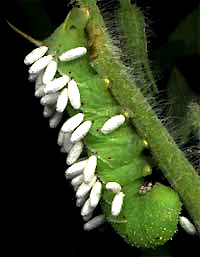 These cocoons were not made by flesh fly maggots but rather by one of many species of Braconid Wasp. That's my scanned image of the same cocoon-covered hornworm I saw at the right.
Braconids are small wasps, and you can bet that my hornworm with 34 cocoons stuck to him will not metamorphose into a sphinx moth, for recently that caterpillar has been tunneled through by at least 34 little maggots who ate much of his interior body. Braconids, along with very closely related Icheneumon Wasps, are important in controlling caterpillar populations. You may have seen them sold in gardening magazines as biological control agents.
During the last couple of weeks I haven't seen a single hornworm who wasn't obviously dying from either a flesh fly or Braconid visit. In the spring when my tomato vines were small and every leaf and bud was a treasure, I may well have presented what hornworms I found to my favorite Fence Lizards or skinks, but right now, by leaving my hornworms alone, I think of myself as feeding the Braconids and flesh flies who next year will help keep down my hornworm population.
from the August 24, 2003 Newsletter, issued from near Natchez, Mississippi:
FLESH FLY & HORNWORM
Wednesday during a late afternoon visit made to two hornworms known to be grazing a certain plant, I was surprised to find the caterpillars quiet, their heads curled beneath them. Looking closer, I saw that the larger caterpillar was blotched with dark green, moist areas, as if bruised, and that a fly was pestering it.
The fly looked a lot like a regular housefly, except that its compound eyes were conspicuously pale tan, the fly's back was striped with silvery lines, it buzzed louder than a housefly, and its aggressive behavior toward the caterpillar was very unlike a housefly's nervous manner of being. Realizing I had a different kind of fly, I got my field guides and handlens, the fly landed and remained still while I looked it over, and I determined that it was one of over 300 North American species of Flesh Fly, of the family Sarcophagidae -- a fly very different from houseflies, blow flies, tachinid flies and the rest.
Soon the fly was at the hornworm again, and this time I saw that frequently he would actually land on the caterpillar for a second or two, and that during that brief landing a tiny, white egg would be laid on the hornworm's green body. The hornworm realized that this was not good news, for again and again it bent its body around and attempted to scrape the eggs off. It couldn't reach its rear-most parts, however, or the region right behind its head, and these were precisely the bruised-looking areas, and the spots where the fly laid most of its eggs.
My fieldguide explained what was happening. Larvae from the eggs would enter the hornworm's body and tunnel through it. Eventually the hornworm would die, but not before the larvae were ready to burrow to the hornworm's skin, where they would metamorphose into adult flesh flies. Most flesh fly species are scavengers, some develop in skin sores of vertebrate animals, and a few feed on insects stored in wasp nests, but clearly here I had one of the several species who parasitize caterpillars.
On Wednesday, the hornworm, the flesh fly, the Four O'clocks, the Moonflower, the sphinx moth, and I all mingled in a congenial, interconnected, mutually sustaining permaculture ecology.