
PLANTS | ANIMALS | ECOLOGY | FUNGI | GEOLOGY | GARDENING | TOOLS
Excerpts from Jim Conrad's
Naturalist Newsletter
from the February 9, 2009 Newsletter, issued from the forest near Natchez, Mississippi; elevation ~400ft (120m), ~N31.47°, ~W91.29°:
A BEAVER LODGE, HIGH & DRY
The other day in a swamp along the Mississippi River on the Louisiana side I visited the beaver lodge shown below.
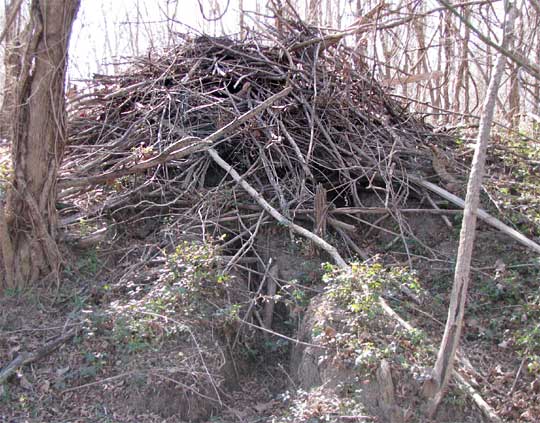
The lodge had been built atop a rise when the Mississippi's water was high, and now that the water is low you can see entrances to the lodge below the pile of sticks. The biggest entrance is in the photo's center, at the bottom. To the left of that entrance is another smaller one. The lodge had about eight entrances, most of them mere tunnels, unlike the big one in the center of the photo, which was more like a deep trench. I was told that when the lodge was built water reached the lodge's base, and the entrance holes were all underwater.
There's a lot more information on Wikipedia's Beaver Dam page.
from the March 23, 2009 Newsletter, issued from the forest near Natchez, Mississippi; elevation ~400ft (120m), ~N31.47°, ~W91.29°:
A CLASSIC BEAVER DAM
Recently we looked at a beaver lodge. This week in the Refuge I ran across a classic beaver dam, shown below:
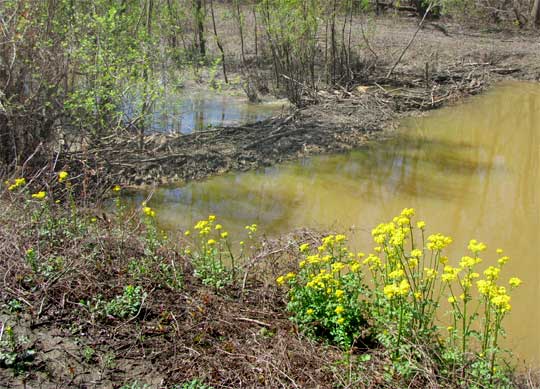
Notice how pooled water on the high, nearer side is muddy while water below the dam looks a bit clearer. Here the dam is fulfilling one of its services to the ecosystem by slowing water down causing eroded soil particles suspended in the water to settle out. The dam thus keeps eroded soil from continuing into rivers downstream. If the dam is permitted to remain, eventually a species-rich "beaver meadow" or marsh will form above the dam.
The Beaver Dam Information Site provides loads of info about beaver dams at http://www.beaverdam.info/.
from the February 29, 2004 Newsletter, issued from near Natchez, Mississippi:
SIGNS OF BEAVER -- OR MAYBE NUTRIA?
For the last two or three weeks, at both the Field Pond and the Forest Pond, something has been gnawing on the stems of Black Willows along the banks. On some willows, debarked patches a foot or more long extend up the trunks, sometimes nearly encircling them. A few stems an inch thick or more have been completely severed as cleanly as with a sharp knife. Several slender, two-ft-long stem segments of 10-ft-high plumegrass (genus Erianthus) float at the water's edge as well. The willows' debarked patches and the floating plumegrass stems are almost white, so in the rain-saturated pond area beneath overcast skies, these signs show up like beacons. In a marshy area where grass emerges from shallow water there's a network of runways, and the water in the runways' vicinity is cloudy.
These are all classic signs of Beaver, CASTOR CANADENSIS. Even before I moved to the Sandy Creek area often I'd admired beaver dams at several locations in Homochitto National Forest, which adjoins this property. Beaver are known to wander five or more miles from their birthplaces, and 150-mile moves have been documented, so there's no reason to be surprised to see beaver signs here.
Still, I can't say with 100% certainty that what I'm seeing is made by beaver, and not nutria, MYOCASTOR COYPUS. I just have no experience with nutria, though in southern Louisiana this rodent has in some places become a major problem. Nutria, nearly as large as beaver, was introduced from Argentina into the US by people hoping to farm them for their fur. Nutria fur never did catch on, animals escaped and were released, and now certain wetlands are being devastated by the rapidly multiplying critters.
The Louisiana Department of Wildlife and Fisheries provides a fine page on the history of nutria in our area, entitled "Nutria Population Dynamics - A Timeline," along with illustrations of them, at www.nutria.com/site2.php.
I'm 99% sure that we have beaver visiting our ponds, not nutria. For one thing, the highest nutria concentrations are a bit south of here. More importantly, the other day I was standing next to a stream in the woods not far from the ponds when suddenly a splash detonated next to me so loud that it only could have been made by a beaver who had surfaced, seen me, then slapped his flat tail on the water before diving to his underwater den entrance. Nutrias don't have flat tails to slap with. Also, nearby was a mammal track in which the footprints were obliterated by something being dragged over them -- like a beaver tail.
Maybe someone out there can tell me how to distinguish gnawings and floating food debris of a beaver from that of a nutria. Do nutria leave broad, flat toothmarks on debarked, standing willow trunks, as beaver do?
from the March 2, 2009 Newsletter, issued from the forest near Natchez, Mississippi; elevation ~400ft (120m), ~N31.47°, ~W91.29°:
BEAVER SAWMILL
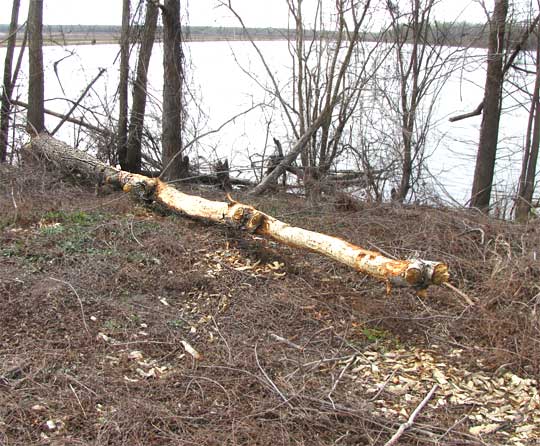
This week at St. Catherine Creek NWR wherever there were trees we saw a lot of beaver activity. Above you see where beaver have toppled a fairly tall Black Willow onto a levee, mostly debarked it and left behind lots of woodchips. The willow had had two trunks and if you look at the very base of the fallen trunk you can see that the remaining stem itself has been gnawed most of the way through and looks about to fall.
I have read that before Europeans came into North America and began killing beavers for commerce the landscape and its ecology was much different from now because beaver had dammed almost every stream, with the dams supporting vast communities of plants and animals, and altering the water tables. The presence of beaver not only encouraged a level of wildlife activity we can only imagine now, but also contributed to long term drainage patterns, and thus the form of the landscape itself.