Miscellaneous Portraits of the order
Hemiptera
(true bugs)
- 0-4, FW thick at base
- mouth: sucking
- tarsi segments: 2-3
- metamorphosis: simple
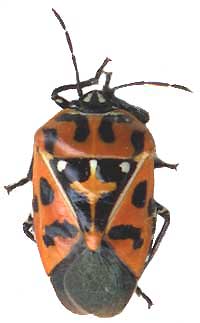 English Name: Harlequin Bug
Family: Pentatomidae (Stink Bugs)
Genus: Murgantia
Species: histrionica
The bug at the right is one of the most beautiful, most common and most destructive species in my gardens. What a tattered mess they can make of my horseradish, my mustard greens, my turnips, my Brussels sprouts and cauliflower! Sometimes hundreds suddenly appear, and often they're stuck together mating, as shown midway down our Bugwatching Page. To make matters worse, in my area sometimes you find them even in mid winter. This bug proves that just because you're very pretty, you're not necessarily rare and exotic. Notice that this bug belongs to the Stink Bug family. That's because species in this family often produce a disagreeable odor if you bother them. That may explain why several species in the family are brightly colored -- to warn predators that if they try to catch this bug, they'll end up with a very bad taste in their mouths! This bug is about half an inch long (11 mm).
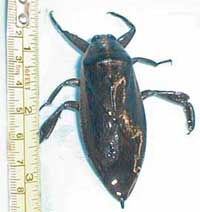 English Name: Giant Waterbug
Family: Belostomidae (Giant Waterbugs)
Genus: Benacus?
Species: ?
The other day my Mississippi neighbor Karen Wise emailed me the image at the right. In her backyard she'd had a bucket with some dirt in it, rain partially filled the bucket, and when Karen tipped it over, the Giant Waterbug at the right was in the mud. After Karen photographed him, he was "released back to a mud and water home." Not only was I tickled to have the picture, but also I was glad Karen hadn't been bitten by the critter, for Giant Waterbugs can inflict painful bites. Notice how the waterbug's back legs are flattened so that they can be paddled through the water. Also see how the front legs are held before it so that it can easily grab its prey -- young fish, tadpoles and other water insects.
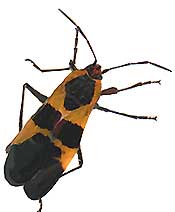 English Name: Large Milkweed Bug
Family: Lygaeidae (seed bugs)
Genus: Oncopeltus
Species: fasciatus
Each summer morning as I bike to work in my gardens I pass through a small population of Green Milkweeds. In June when the milkweed fruit-pods were opening and white-parachuted seeds were being released, for several days I was seeing the bug at the right. Not just one, but about twenty, all clustered together, some with well developed wings and some with only wing buds. This is normal for all members of the Hemiptera, for they undergo simple metamorphosis, not complete. Milkweeds are filled with bitter, often poisonous, chemicals. When milkweed bugs eat milkweed seeds they take the bitter chemicals into their bodies, and in doing so become too bitter for predators to eat. This explains why this bug is so bright. It is bright, instead of well camouflaged, in order to warn predators that it is bitter. Its story is similar to that of the Monarch Butterfly, which also is brightly colored, and which also, because the larvae eat milkweed leaves, are too bitter for most predators to eat.