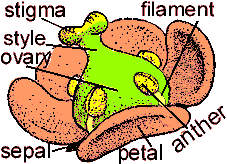
 Like snowflakes, the flowers of no two plant species are exactly alike. When you consider that blossoms have so few visible basic parts, this is an amazing fact.
Here's a quick look at how the main parts of a flower can vary from species to species:
THE CALYX
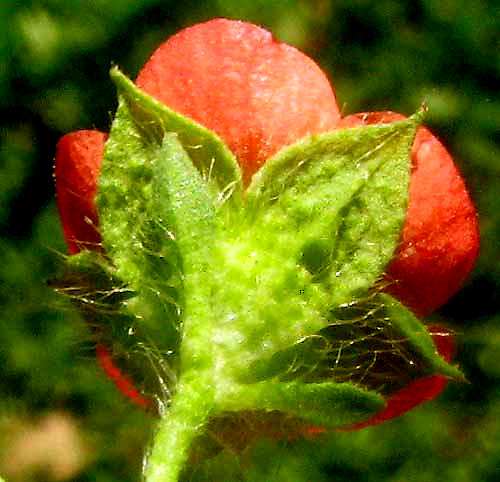
The green calyx of the Bristlemallow, Modiola caroliniana, shown at the left is a good "standard calyx," in that it's a green, bowl-like affair composed of five lobes, or sepals. Note that below the calyx two or three small, leafy appendages appear. These are bracts, or modified leaves, and in some species they appear below a calyx and in other they don't.
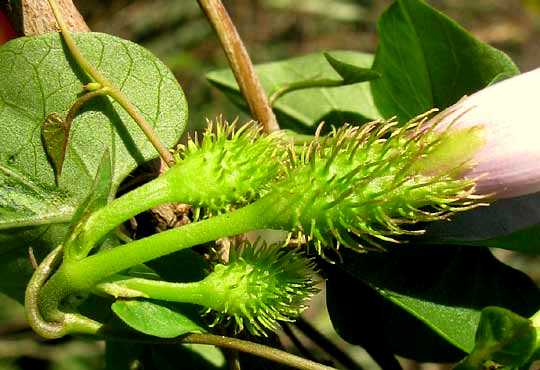
Sometimes the calyx does defense duty, as seen at the right with the tropical morning-glory species Ipomoea crinicalyx. If a caterpillar comes up the stem ready to eat the flower, or a nectar-robbing bee wants to steal nectar when the flower is closed, they'd have to deal with the spines.
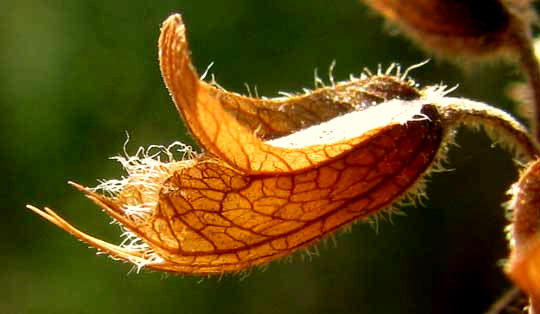
Other times the calyx does seed-dispersal duty, as with the tropical Wild Basil, Ocimum campechianum, shown at the left. The plant's fruits, ready to be transferred into new territory for planting, reside inside the dried-up, papery calyx. When a good wind catches in the sail-like part atop the calyx, it shakes the calyx, the dry fruits are jarred loose, and maybe with levering-help from long spines on the lower sepal tips, the shaking slings the fruits from the parent plant. This calyx also differs from our "standard" concepts in that it's bilaterally symmetrical, or "irregular," meaning that there's only one way (vertically) to cut through the calyx lengthwise so that each resulting side is a mirror image of the other.
THE COROLLA
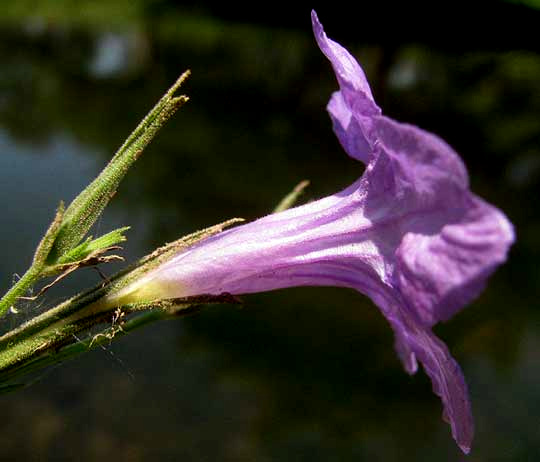
Probably the most commonly encountered departure from the corolla of our Standard Blossom, which consists of five separate petals, is shown by the Wild Petunia, Ruellia nudiflora, at the right. Instead of separate petals, it consists of a corolla tube with five lobes.
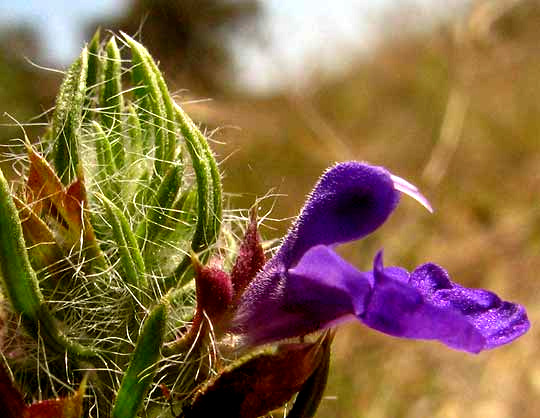
As with calyxes, another common departure from our concept of a "standard corolla" is that often a species' corolla shows bilateral symmetry, as does that of the Texas Sage, Salvia texana, seen at the left. That flower provides a nice landing pad for its pollinators, with the top corolla lobes forming a protective ceiling over the sexual parts.

Sometimes a calyx's sepals are so similar in size, color and texture to the corolla's petals that the calyx and corolla together are thought of as one thing, the perianth, and the individual parts are called tepals. Such is the case with the False Garlic, Nothoscordum bivalve, shown at the right. Those white items are tepals.
STAMENS
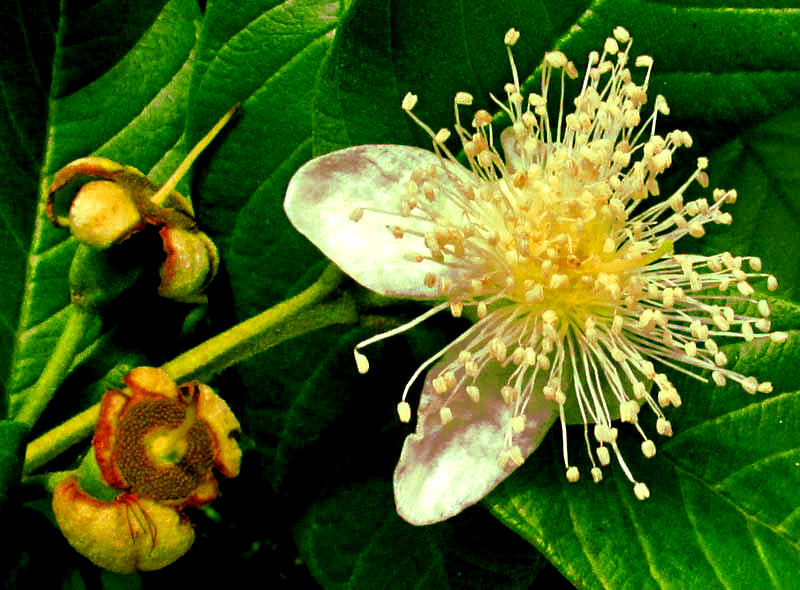
Stamens do all kinds of tricks, and maybe the most frequently seen departure they make from our concept of "standard stamens" is that there's not just five of them, as in our Standard Blossom, but more or fewer. At the left, the flower of a Guava tree, Psidium guajava, hints at the possibilities.
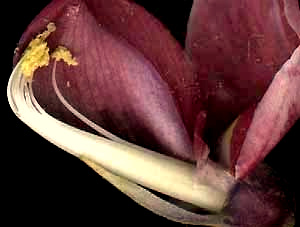
At the right, a blossom of the Kudzu vine, Pueraria montana, shows a peculiar condition commonly seen in the big Bean Family. Of the ten stamens, the filaments of nine are fused along their edges to form a cylinder around the flower's style. However, the cylinder is split on one side, where one of the stamens is held apart. Such stamens are said to be diadelphous. Some flowers have all their stamens' filaments united, and those are monadelphous
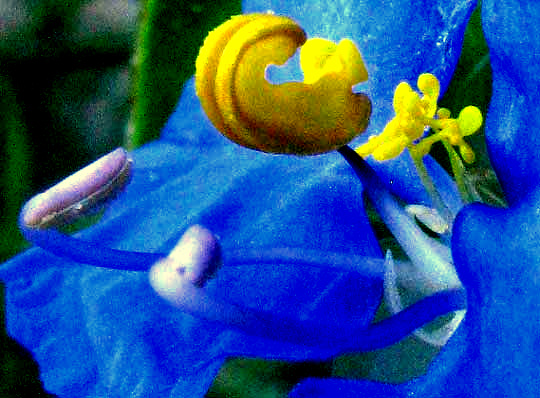
At the left, stamens of the Whitemouth Dayflower, Commelina erecta, are behaving so weirdly that one may need the authoritative Flora of North America to describe what's going on. Of stamens in the genus Commelina the Flora says: "stamens (5--)6, proximal 3 fertile, medial different in form, size from others, distal (2--)3 staminodial. In other words, in Commelina there are six, sometimes five, stamens, the three closest to the blossom's base ("proximal") being normal stamens but those farther from the base ("distal"), are "staminodes," or modified stamens. Staminodes, if they produce pollen at all, usually produce sterile or only weakly fertile pollen. It's unclear how such staminodes as the pale blue hocky-stick-like things and the big yellow item looking like a split banana wearing glasses benefit the plant.
PISTILS
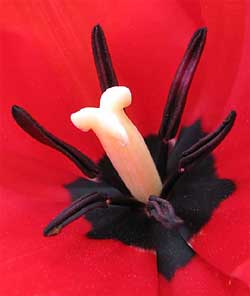
In the red garden tulip blossom at the right, the white thing is the pistil, with six black stamens radiating from its base. Atop the pistil is a three-lobed stigma. The pistil's thick lower part is the ovary. The slightly narrowed zone between the stigma and ovary is the style, though most styles are longer and narrower. Some might argue that in this flower there's no style at all, and that's OK.
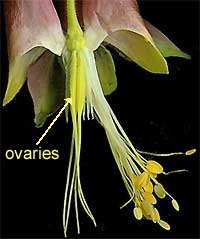
At the left, a columbine flower, genus Aquilegia, displays a radical but frequently encountered variation on the pistil theme presented by our Standard Blossom. Instead of the flower producing just one pistil, there are several -- their ovaries identified in the picture. There the ovaries bear long, slender styles, but there's hardly a hint of a stigma. In fact, it's said that the columbine flower's long, slender filaments gradually taper to a "stigmatic tip," "stigmatic" meaning "functioning like a stigma." Lots of pistils have no discernible, knobby stigma, just such a "stigmatic" zone at the style's end.
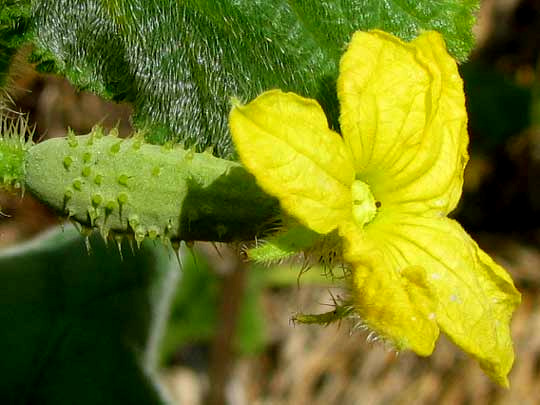
Another commonly seen but profound difference from our concept of the "standard pistil" is shown by the female flower of the garden Cucumber, Cucumis sativus, shown at the right. There, the spiny, pickle-like item is the ovary, the future cucumber. In our Standard Blossom, the calyx, corolla and stamens all issue from below the ovary, and such ovaries are said to be "superior." The Cucumber vine's flowers have "inferior" ovaries, in which the calyx, corolla and stamens arise above the ovary.
ORCHIDS & SUCH
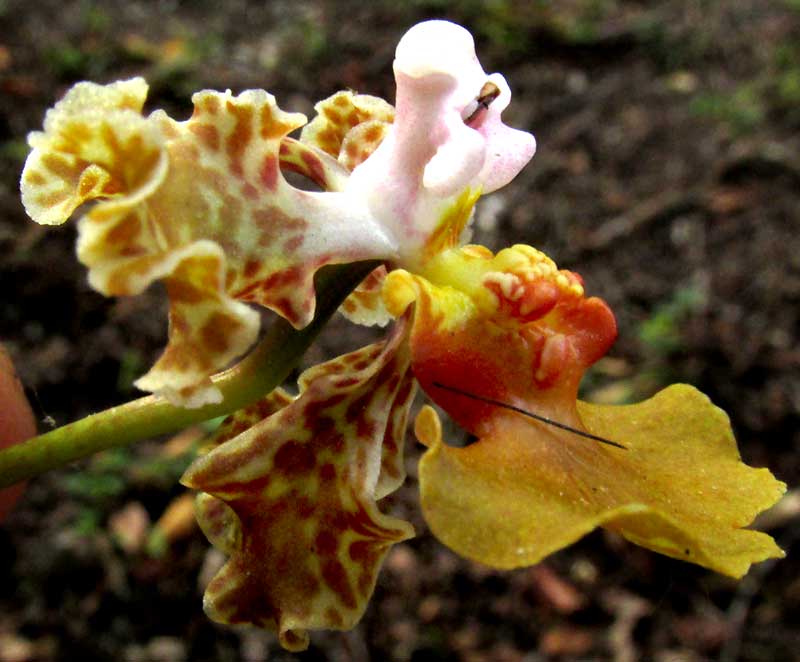
And then there are flowers like that of the Dancing Lady Orchid, Trichocentrum ascendens, featured at the left. This flower is so specialized with so many unusual adaptations that our Standard Blossom concept hardly helps at all. What's going on is that the Orchid Family, as well as the Aster or Composite, and the Grass Families, all are "recently evolved" kinds of plants. On the phylogenetic Tree of Life, they occupy the outermost branches, with early-evolved plant families with simpler flowers, closer to the roots of the Tree of Life, more like our Standard Blossom. We recently-appeared humans occupy a position at one of the Tree of Life's outermost branches.
Nature's evolutionary impulse appears to be toward ever greater diversity, with ever more intricate and specialized interrelationships among the diverse natural things. In recently arisen plant families, often you find flower parts fused together, reduced in size, functioning ever more efficiently. They're elegant in their own way, as with the Dancing Lady, but you see little of what's in a big, luscious, perfumy, extravagantly beautiful but "primitive" magnolia blossom.
With flowers like those of the Dancing Lady, if you want to understand what you're seeing, look for specialized help. A good start would be Wikipedia's Orchid Flower section.