PLANTS | ANIMALS | ECOLOGY | GEOLOGY | GARDENING | TOOLS
MEXICAN PLANTS & ANIMALS HOME

Excerpts from Jim Conrad's
Naturalist Newsletter
from the January 28, 2007 Newsletter issued from Yerba Buena Clinic just outside Pueblo Nuevo Solistahuacan, Chiapas, MÉXICO
about 1740 meters in elevation, ± LAT. 17° 11' 27"N, LONG. -92° 53' 35"W
"INDIAN PAINTBRUSHES"
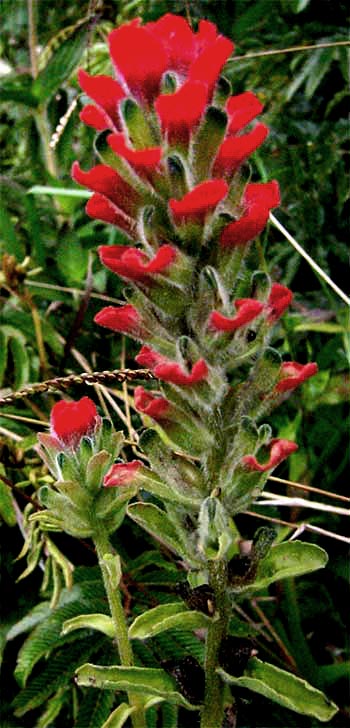
Quotation marks appear around the name because "Indian Paintbrush" is one of those names people give to any and all red-topped wildflowers. Overuse makes the name practically useless. However, I can't think of any other English Name for the red-topped plant nowadays growing weedily and prettily along our roads. That's one above.
That's a member of the genus Castilleja, of which Breedlove's Flora of Chiapas lists five species for Chiapas. Here "Indian Paintbrushes" are called "Cola de Borregos," or "Sheep-tails." In North America several Castilleja species are favorite wildflowers so in your wildflower book you may want to see if species live in your area. They're worth looking for.
The red items in the picture are not flowers, but rather "bracts," or modified leaves, which arise below each small, barely noticeable flower. The dark-tipped, yellowish-green items that might be flowers are actually just the calyx's two sepals extending above and around the very small, bean-flower-like blossoms. At the bottom of the larger plant you can see dark brown fruits containing many tiny seeds.
During nearly all my wildflower-sniffing career I've accepted that the genus Castilleja belongs in the Figwort or Snapdragon Family, the Scrophulariaceae. However, recent genetic studies have shifted Castilleja to the Broomrape Family, the Orobanchaceae, in which reside such weird, non-green, root-parasitizing plants as Squawroot, Beechdrops and Cancer-root.
At first this reclassification seemed absurd but then it began dawning on me that Castilleja's flowers and fruits are indeed very similar to those of Squawroot and the others, and taxonomy, at least traditionally, has always been predominantly based on features of flowers and fruits. Apparently all these years taxonomists have been so blinded by the fact that Castillejas bear green leaves that they failed to appreciate the similarities of the genus's flowers and fruits with those of the Broomrape Family.
Similarly, until recently taxonomists regarded all members of the Broomrape Family as non-green, non-photosynthesizing root parasites, but now genetic sequencing shows that the family can be regarded as being in a state of transition, evolving from a primitive non-parasitic state to a more complex, completely parasitic one. Castillejas also steal part of their food from the roots of other plants, even as they manufacture part of their food through photosynthesis.
You wildflower connoisseurs may also be surprised that the common wildflowers once placed in the genus Gerardia now have been broken up and shifted to the same Broomrape Family along with Castillejas, and are also semi-parasitic on other plants' roots.