PLANTS | ANIMALS | ECOLOGY | GEOLOGY | GARDENING | TOOLS
MEXICAN PLANTS & ANIMALS HOME

Excerpts from Jim Conrad's
Naturalist Newsletter
from the February 11, 2008 Newsletter written in the community of 28 de Junio, in the Central Valley 8 kms west of Pujiltic, elev. ~700m (2300ft), ~N16.331°, ~W92.472°; southeastern Chiapas state, MÉXICO
BARRED ANTSHRIKES
The other day I found the feather shown below.
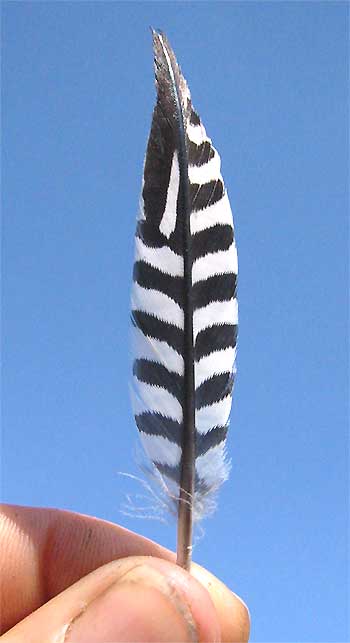
Not many bird species possess the spectacular black- and-white, Zebra-stripe barring such feathers impart. I could think of just two local candidates. One is the Golden-fronted Woodpecker, closely related to the North's Red-bellied Woodpecker, whose back is bared with narrow, black and white stripes. The other possibility is the Barred Antshrike. Since Barred Antshrikes were calling like crazy that morning with their 6-8 nasal kyow notes, rising then falling, my guess is that that's a Barred Antshrike feather in the picture.
As feathers go, it's an impressive one. Note the black streak at the feather's upper, left. Just think of the evolutionary trial-and-error needed to position that streak perpendicularly to all the others. Nature employs all kinds of tricks for creating ornamentation in systematic ways, but coming up with something running counter to already existing patterns can be an extra challenge.
Antshrikes themselves belong to the neotropical Antbird Family, the Formicariidae. In Mexico the family is represented by four antshrike species, one antvireo species, four antbird species, one antthrush, and one antpitta. The "ant" part of the names comes from the tendency of some of the family's species to accompany army-ant swarms and prey upon fleeing insects.
Evolutionarily the family appears to specialize in "radiating" -- emulating species in other birds groups, thus eventually looking and behaving somewhat like shrikes, vireos, thrushes, etc. Many families specialize in efficiently exploiting just one general niche, such as woodpeckers on tree trunks, or wood warblers foraging for insects among tree branches, thus a certain conformity of appearance and behavior unites the whole family. The Antbird family takes the opposite approach.
One of the most striking features of our Barred Antshrike species is its sexual dimorphism; males and females look so unlike one another that it's hard to believe they're they same species. The male has his intense Zebra-striping, but the female is mostly a plain, rusty-red or rufous bird, with only modest striping on her cheeks.
The species is distributed in second growth, forest edges, thickets and such from Mexico's north-central Gulf lowlands south to northern Argentina.